

Celadon
Historical Overview
Celadon (Qing 色)
📖 Why “Celadon”?
The name comes not from China, but from a 17th-century French literary character — Céladon, a shepherd who wore pale green ribbons in the popular romance L’Astrée. Europeans later borrowed his name to describe the soft green Chinese ceramics they admired.
The name comes not from China, but from a 17th-century French literary character — Céladon, a shepherd who wore pale green ribbons in the popular romance L’Astrée. Europeans later borrowed his name to describe the soft green Chinese ceramics they admired.
Celadon (Qingci) — How to Read It
Beginner view:
Celadon is not read by colour alone. Collectors look for how the glaze sits on the body, how light moves across the surface, and how controlled the firing appears.
For beginners, focus on:
Celadon is not read by colour alone. Collectors look for how the glaze sits on the body, how light moves across the surface, and how controlled the firing appears.
For beginners, focus on:
- Does the glaze appear calm, even, and softly luminous?
- Are carved details visible beneath the glaze rather than floating on top?
- Does the surface feel more like polished stone than glass?
- Is the colour subtle rather than bright or glossy?
Tip: With celadon, restraint and balance usually signal quality more than decoration.
Expert view:
Experienced collectors evaluate celadon through glaze chemistry, kiln control, and historical intent rather than colour alone.
Experts assess:
Experienced collectors evaluate celadon through glaze chemistry, kiln control, and historical intent rather than colour alone.
Experts assess:
- Iron content and reduction balance affecting green tone
- Glaze thickness and pooling along carved recesses
- Body density and firing temperature consistency
- Stylistic dialogue with Song, Longquan, or imperial Qing models
Note: In celadon, technical restraint often reflects higher mastery than surface brilliance.
Introduction: Celadon as a Major Ceramic Tradition
🌍 The name is European. The idea is Chinese.
Chinese potters never used the word “celadon.” They spoke instead of jade likeness, glaze harmony, and firing balance — concepts rooted in philosophy, not colour.
Chinese potters never used the word “celadon.” They spoke instead of jade likeness, glaze harmony, and firing balance — concepts rooted in philosophy, not colour.
Attribution Confidence — Chinese Celadon (Qingci)
55%Slide to explore glaze quality, kiln control, and stylistic certainty
Moderate confidence.
The piece shows celadon characteristics, but glaze tone, firing control, or stylistic alignment are not yet fully diagnostic.
The piece shows celadon characteristics, but glaze tone, firing control, or stylistic alignment are not yet fully diagnostic.
- Green tone broadly consistent with celadon
- Glaze pooling present but not decisive
- Form may span multiple periods
Celadon is not merely a glaze colour but one of the great, continuous ceramic traditions of China, comparable in cultural importance to blue‑and‑white porcelain or famille rose enamels. For more than a millennium, celadon embodied the highest ideals of Chinese aesthetics: restraint over display, harmony over excess, and spiritual depth over surface brilliance. Its subtle green tones, often likened to jade, positioned celadon at the intersection of material culture, philosophy, ritual, and scholarly taste.
Although the European term celadon emerged only in the nineteenth century, Chinese potters had already developed a sophisticated vocabulary to describe these wares, focusing not on colour alone but on firing temperature, glaze behaviour, body quality, and visual balance. Across dynasties, celadon evolved technically and stylistically while maintaining a coherent aesthetic identity.
🧪 Celadon is not a colour.
It is the result of iron content, reduction firing, glaze thickness, and cooling speed — not a pigment. Two bowls from the same kiln can look completely different.
It is the result of iron content, reduction firing, glaze thickness, and cooling speed — not a pigment. Two bowls from the same kiln can look completely different.
Defining Celadon: Technology and Aesthetics
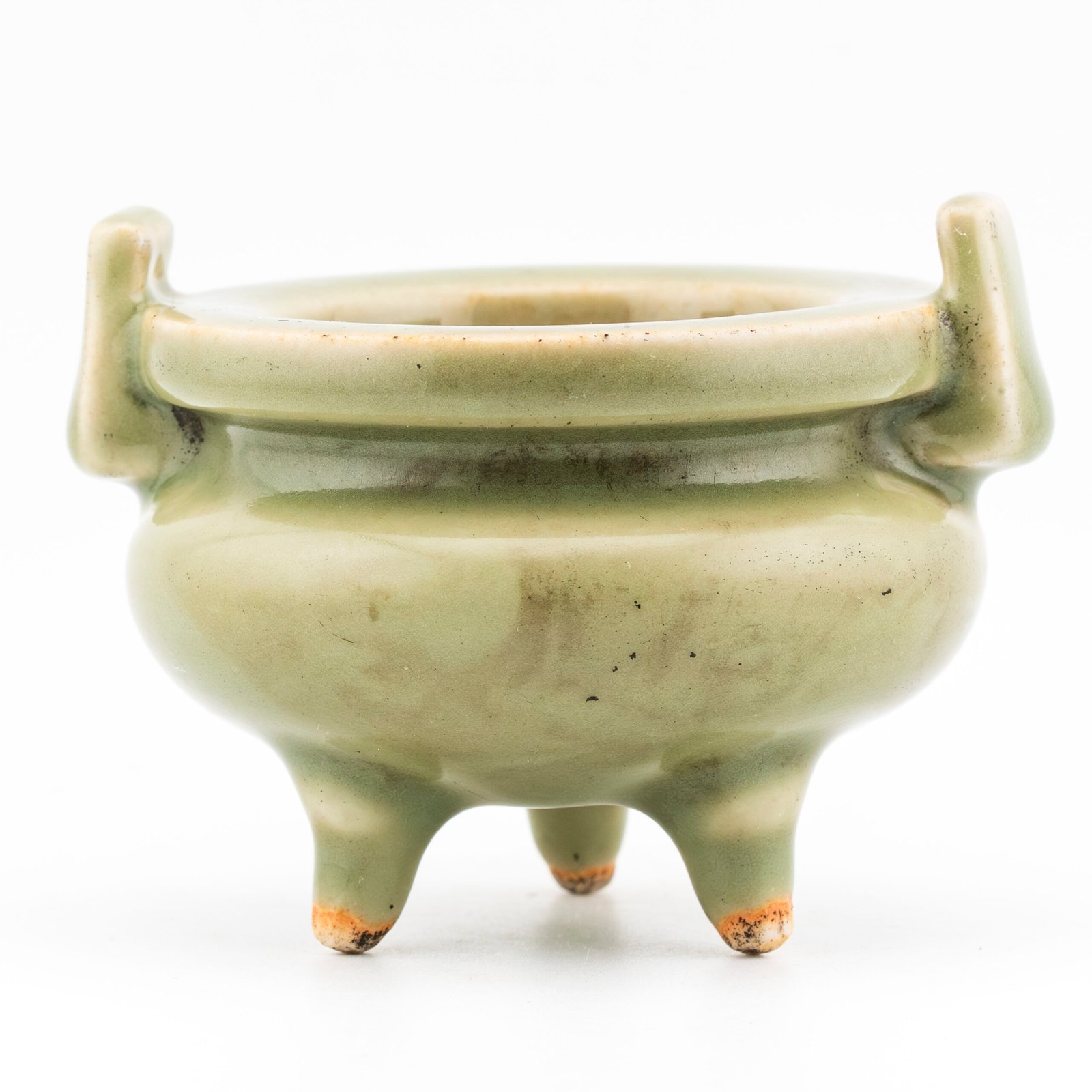
Celadon refers to high‑fired stoneware or porcelain coated with iron‑bearing glazes fired in a reducing atmosphere. The iron content, kiln atmosphere, and cooling cycle together determine the final colour, which may range from bluish green and grey‑green to olive, pea green, or pale jade tones.
Unlike decorative enamels or painted wares, celadon relies on:
- Controlled kiln atmosphere (reduction firing)
- Precise glaze chemistry
- Surface interaction between glaze, body, and light
- Subtle form and proportion, rather than overt ornament
The finest celadons are admired not for brilliance but for depth, texture, and quiet luminosity, qualities long associated with cultivated taste.
🪨 Jade was the goal — not green.
The finest celadon aimed to imitate polished nephrite: calm, deep, and softly luminous rather than bright or glossy.
The finest celadon aimed to imitate polished nephrite: calm, deep, and softly luminous rather than bright or glossy.
Philosophical and Cultural Meaning
Celadon’s resemblance to jade (yu) is central to its cultural status. In Chinese thought, jade symbolised moral integrity, restraint, purity, and harmony between heaven and earth. Celadon offered a ceramic analogue to jade, accessible yet deeply symbolic.
For scholars and officials, celadon aligned with Confucian and Daoist ideals:
- Confucian restraint in form and colour
- Daoist naturalness in glaze flow and surface variation
- Buddhist serenity, particularly in ritual and temple wares
This philosophical alignment explains why celadon was repeatedly favoured during periods of cultural consolidation and intellectual refinement.
⚠️ Too perfect can be a warning.
Completely even colour and glassy surfaces may suggest later production. Early celadon often shows pooling, variation, and soft unevenness.
Completely even colour and glassy surfaces may suggest later production. Early celadon often shows pooling, variation, and soft unevenness.
Early Origins: Proto‑Celadon and Yue Ware
The foundations of celadon lie in early high‑fired glazed stonewares of southern China. By the Eastern Han and Six Dynasties periods, potters had already achieved proto‑celadon glazes, though colour control remained uneven.
True maturity emerged at the Yue kilns of Zhejiang during the Tang dynasty. Yue celadon is characterised by:
- Thinly potted, elegant forms
- Smooth, glassy glazes
- Olive‑green to grey‑green tones
- Exceptional firing consistency for the period
Elite Yue wares were praised as Mi se (秘色, “secret colour”), a courtly term denoting the highest quality rather than a separate category. Archaeological discoveries from temple deposits confirm their use in imperial and religious contexts.
🕸️ Crackle is not always damage.
In Guan- and Ge-style wares, controlled crackle was admired — a sign of stress deliberately built into the glaze.
In Guan- and Ge-style wares, controlled crackle was admired — a sign of stress deliberately built into the glaze.
Northern Innovation: Yaozhou Celadon
In northern China, celadon developed along a different aesthetic trajectory. Yaozhou ware, produced in Shaanxi from the Tang through the Jin dynasties, emphasised sculptural decoration beneath celadon glaze.
Typical features include:
- Deeply carved or molded floral scrolls
- Lotus, peony, dragons, phoenixes, and Buddhist motifs
- Thicker glaze pooling in recesses
- Strong visual contrast between relief and surface
Yaozhou celadon demonstrates how celadon could accommodate bold decoration without sacrificing refinement. Its large‑scale production and technical innovations allowed it to supply court, temple, and domestic markets alike.
⚖️ Thickness tells a story.
Thicker bodies and heavy glazes often point to Longquan traditions, especially in Southern Song and Yuan wares.
Thicker bodies and heavy glazes often point to Longquan traditions, especially in Southern Song and Yuan wares.
Imperial Perfection: Ru Ware
Among all celadon traditions, Ru ware occupies a unique and exalted position. Produced briefly for the Northern Song court, Ru ware was reserved exclusively for imperial use.
Ru celadon is distinguished by:
- Pale bluish‑green glaze, often compared to a duck’s egg or misty sky
- Fine, natural crackle
- Full glaze coverage with tiny spur marks
- Utterly restrained forms
Its rarity and refined aesthetic have made Ru ware one of the most revered and studied ceramic types in the world, representing the philosophical ideal of celadon taken to its extreme.
⚠️ Myth: greener means better.
Some of the most admired celadons are grey-green, bluish, or softly olive. Depth, surface calm, and control matter more than brightness.
Some of the most admired celadons are grey-green, bluish, or softly olive. Depth, surface calm, and control matter more than brightness.
Longquan Celadon: Song to Yuan Expansion
The Longquan kilns of southern Zhejiang became the dominant producers of celadon from the Southern Song period onward.
Song Dynasty Longquan wares are noted for:
- Thick, jade‑like glazes
- Soft, rounded forms
- Minimal decoration
- Exceptional surface depth
During the Yuan dynasty, Longquan production expanded dramatically. Forms became larger and heavier, decoration more pronounced, and output increased to meet export demand. Longquan celadon became one of China’s most widely traded ceramic products, found across East Asia, Southeast Asia, the Middle East, and Africa.
This period marks celadon’s transformation from elite court ware to a global luxury commodity.
📜 The Song dynasty changed everything.
Song potters refined celadon into a philosophy of restraint. Decoration became secondary to form, glaze, and quiet balance.
Song potters refined celadon into a philosophy of restraint. Decoration became secondary to form, glaze, and quiet balance.
Celadon Beyond China: East Asia and the Islamic World
Celadon exerted profound influence beyond China:
- Korea developed the Goryeo celadon tradition, renowned for inlay decoration
- Japan admired and collected Chinese celadon, influencing tea aesthetics
- Islamic courts prized celadon for its cool colour and legendary resistance to poison
Shipwreck discoveries confirm the scale and prestige of celadon in global trade networks.
👑 Why Qing celadon feels controlled.
Imperial kilns sought consistency. Qing celadon often imitates earlier Song ideals — but with tighter technical precision.
Imperial kilns sought consistency. Qing celadon often imitates earlier Song ideals — but with tighter technical precision.
Qing Dynasty Revival and Transformation
Under the Qing dynasty, celadon experienced a conscious revival driven by antiquarian interest and imperial patronage. Jingdezhen kilns produced celadon wares inspired by Tang and Song models while achieving unprecedented technical control.
Kangxi celadon displays:
- Pea green, pale green, and imitation Longquan tones
- Relief dragons, waves, and cloud motifs
- Experimental glaze effects alongside historical imitation
Yongzheng celadon is widely regarded as reaching an artistic peak, characterised by:
- Extremely smooth, controlled glaze surfaces
- Elegant proportions
- Light emerald and jade‑like hues
These wares reflect Qing intellectual culture, where mastery was demonstrated through controlled revival rather than innovation alone.
🧠 Celadon is read slowly.
It reveals itself with light, movement, and time. Collectors learn to tilt, pause, and look again.
It reveals itself with light, movement, and time. Collectors learn to tilt, pause, and look again.
Decorative Motifs and Forms in Celadon
Although celadon favours restraint, decoration plays a crucial supporting role. Common motifs include:
- Dragons (often hornless, emerging from waves or clouds)
- Lotus and floral scrolls
- Abstract waves and incised textures
- Basket‑weave and ribbed surfaces
Forms range from ritual vessels and jars to bowls, dishes, cups, and scholar’s objects, each designed to complement the glaze rather than compete with it.
🧭 A quiet rule of thumb.
If a celadon shouts, be cautious. The best ones whisper.
If a celadon shouts, be cautious. The best ones whisper.
Collecting and Appreciation
Celadon rewards slow looking. Collectors assess:
- Glaze depth and evenness
- Colour nuance under changing light
- Relationship between glaze and form
- Firing marks, spur scars, and kiln character
Unlike brightly decorated wares, celadon’s beauty often reveals itself gradually, making it especially appealing to experienced collectors and scholars.
💎 Jade was the ideal.
Celadon was never meant to shine like glass. Its soft glow echoes polished jade — valued in China for purity, restraint, and moral balance.
Celadon was never meant to shine like glass. Its soft glow echoes polished jade — valued in China for purity, restraint, and moral balance.
Legacy of Celadon
Across more than a thousand years, celadon has remained a benchmark of ceramic refinement. Its technical demands, philosophical resonance, and understated beauty ensure its enduring status as one of the most important traditions in Chinese ceramics.
For collectors, celadon offers not spectacle but depth; not novelty but continuity; and not surface decoration but an intimate dialogue between material, fire, and form.
🔥 Two bowls, one kiln.
Two vessels fired together can look completely different. This unpredictability is not a flaw — it is the essence of celadon.
Two vessels fired together can look completely different. This unpredictability is not a flaw — it is the essence of celadon.
Selected References
- Rose Kerr, Chinese Ceramics: Porcelain of the Qing Dynasty 1644–1911
- Nigel Wood, Chinese Glazes
- Palace Museum, Beijing collections
- Victoria and Albert Museum, London
Scholarly References & Source Literature
This Celadon overview is informed by authoritative museum catalogues and academic publications. While the text above is an original synthesis written for OTOAntiques, it draws upon the following key references, which are widely regarded as standard works in the field of Chinese ceramics:
Primary Reference Works
- Sam Marsh, Brushpots: A Collector’s View, Hong Kong, 2007.
- Li Zhiyan, Virginia L. Bower, and He Li (eds.), Chinese Ceramics: From the Paleolithic Period through the Qing Dynasty, Yale University Press / Beijing, 2010.
- He Li, Chinese Ceramics: A New Comprehensive Survey, Thames & Hudson, London.
- Regina Krahl, Chinese Ceramics from the Meiyintang Collection, Vols. I–IV, Azimuth Editions.
- Jessica Rawson, Chinese Ceramics: A Sense of Place, British Museum Press.
- Rose Kerr, Chinese Ceramics: Porcelain of the Qing Dynasty, British Museum Press.
- Nigel Wood, Chinese Glazes, A&C Black / University of Pennsylvania Press.
Museum collections and comparative material referenced include the Palace Museum, Beijing, National Museum of China, British Museum, Musée Guimet, and Royal Ontario Museum.
🧘 Calm surfaces often mean quality.
In celadon, restraint usually signals confidence. Loud colour or decoration is rarely the goal.
In celadon, restraint usually signals confidence. Loud colour or decoration is rarely the goal.
Celadon — Advanced Scholarly Overview (Expert Level)
Terminology and Classification
In traditional Chinese ceramic taxonomy, celadon belongs to the broader category of qingci (青瓷), literally “green ware,” a term defined not by colour alone but by firing temperature, body vitrification, and glaze chemistry. Unlike Western classifications that separate porcelain and stoneware primarily by whiteness or translucency, Chinese systems emphasize firing maturity (huo hou) and glaze–body integration.
Early texts distinguish between low-fired earthenwares (taoqi) and high-fired wares (ciqi), within which celadon represents one of the earliest fully realized glazed stonewares. The frequent interchangeability of terms such as “proto-porcelain” (yuanshi ci) and “proto-celadon” (yuanshi qingci) in modern scholarship reflects this developmental continuum rather than discrete categories.
🏛️ Qing celadon tested mastery.
Imperial kilns used celadon to prove firing control — subtle colour shifts revealed success or failure instantly.
Imperial kilns used celadon to prove firing control — subtle colour shifts revealed success or failure instantly.
Glaze Chemistry and Kiln Atmosphere
Celadon glazes are iron-based, typically containing less than 3% iron oxide. Their colour results from the reduction of ferric oxide (Fe₂O₃) to ferrous oxide (FeO) within a carefully controlled low-oxygen kiln atmosphere. Small fluctuations in oxygen levels, cooling rates, or kiln position could dramatically alter the final hue, producing tones ranging from bluish-green and grey-green to olive and yellow-green.
The dragon kiln (longyao), particularly in southern China, was central to celadon’s development. Its length and gradient allowed high temperatures exceeding 1,250–1,300°C but made uniform firing difficult, accounting for tonal variation even within a single firing. Such variation was not considered a flaw but an intrinsic aesthetic quality.
🚢 Export reshaped celadon.
From the Yuan period onward, celadon was made larger, thicker, and more durable to survive long-distance sea trade.
From the Yuan period onward, celadon was made larger, thicker, and more durable to survive long-distance sea trade.
Early Development: Yue and Proto-Celadon (Eastern Han–Six Dynasties)
The earliest mature celadons emerged from Yue kilns in Zhejiang during the Eastern Han period. These wares, often modest in form—bowls, jars, basins—are characterized by olive-green glazes pooling thickly in incised decoration. Their restrained surfaces already exhibit the philosophical alignment between celadon and jade, long regarded as the highest material ideal in Chinese culture.
🧠 A quiet reminder for collectors.
If the name came from a novel, not a kiln, then colour alone can never be the answer. Celadon must be read — not just seen.
If the name came from a novel, not a kiln, then colour alone can never be the answer. Celadon must be read — not just seen.
Northern Celadon: Yaozhou and Related Kilns
Northern celadon traditions, particularly Yaozhou, favored carved and moulded decoration beneath thinner, more transparent glazes. Motifs such as lotus, peony, scrolling foliage, and animals were deeply carved to exploit glaze pooling. The resulting contrast between relief and ground exemplifies Northern Song taste for clarity, rhythm, and controlled ornament.
💬 Celadon is a name born from admiration.
Europeans struggled to describe these wares, so they reached for poetry and literature. The name reflects wonder — not classification.
Europeans struggled to describe these wares, so they reached for poetry and literature. The name reflects wonder — not classification.
Imperial Celadon: Ru Ware
Ru ware occupies a singular position in celadon history. Produced for the Northern Song court in extremely limited quantities, Ru wares are distinguished by their pale blue-green glaze, soft lustre, and fine crackle. Forms are restrained and ritualistic, reinforcing the Confucian ideals of moderation and refinement. Later imperial celadons repeatedly sought to emulate Ru, though never fully replicating its subtlety.
🎭 Europe named it after a story, not a kiln.
Unlike “Longquan” or “Yue,” the word celadon has no geographic meaning. It reflects European imagination responding to Chinese restraint and subtlety.
Unlike “Longquan” or “Yue,” the word celadon has no geographic meaning. It reflects European imagination responding to Chinese restraint and subtlety.
Southern Apex: Longquan Celadon
Longquan kilns represent the technical and artistic apex of celadon production. Their thick, jade-like glazes—often bluish-green with a waxy surface—allowed for large, monumental forms such as meiping vases, chargers, and jars. Longquan celadon became one of China’s most significant export ceramics, circulating throughout East Asia, Southeast Asia, the Islamic world, and beyond.
Yuan and Ming Transitions
During the Yuan and early Ming periods, celadon production adapted to new market demands. While Longquan continued, its wares grew heavier and more robust, reflecting changing taste and large-scale export. Celadon increasingly coexisted with blue-and-white porcelain rather than dominating the ceramic landscape.
Qing Dynasty Revivals and Innovation
The Qing dynasty witnessed a conscious revival of earlier celadon traditions, particularly under Kangxi and Yongzheng. Imperial kilns at Jingdezhen produced refined celadons in pea-green (douqing), powder-blue-green, and imitation Longquan glazes. Relief decoration featuring waves, dragons, and archaistic motifs reflects antiquarian interests and technical virtuosity.
Yongzheng celadon porcelains, often lighter in tone and exceptionally smooth, represent a peak of imperial refinement, blending Song-inspired aesthetics with Qing technical precision.
Aesthetic Philosophy and Cultural Meaning
Celadon’s enduring prestige lies in its association with jade—symbolizing purity, moral integrity, and harmony. Its subtle surfaces reward close viewing rather than immediate visual impact, aligning with literati values of restraint, contemplation, and inner cultivation.
Collecting Considerations
For advanced collectors, celadon should be evaluated by:
- Body colour and degree of vitrification
- Glaze thickness, tone, and pooling
- Kiln tradition and firing characteristics
- Form and proportional harmony
- Evidence of historical use, burial, or export
Colour alone is insufficient for attribution; understanding kiln technology and historical context is essential.
This expert-level Celadon section forms part of the OTOAntiques Decorative Archive, created to support serious collectors, researchers, and institutions.
Objects from this Period or Antique Examples
Sort by:
Rated 5 out of 5
£52.51
Rated 5 out of 5
£500.01