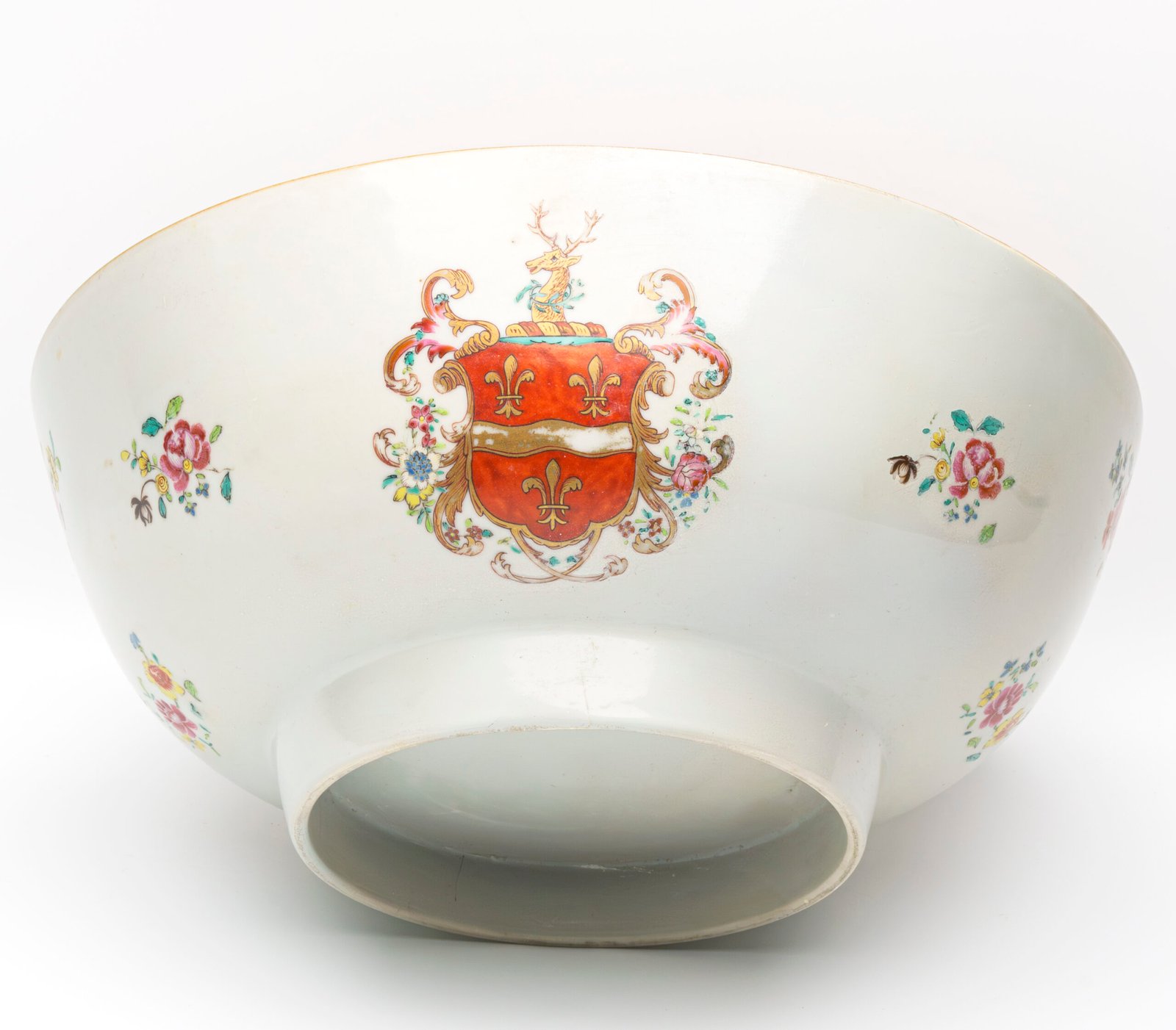
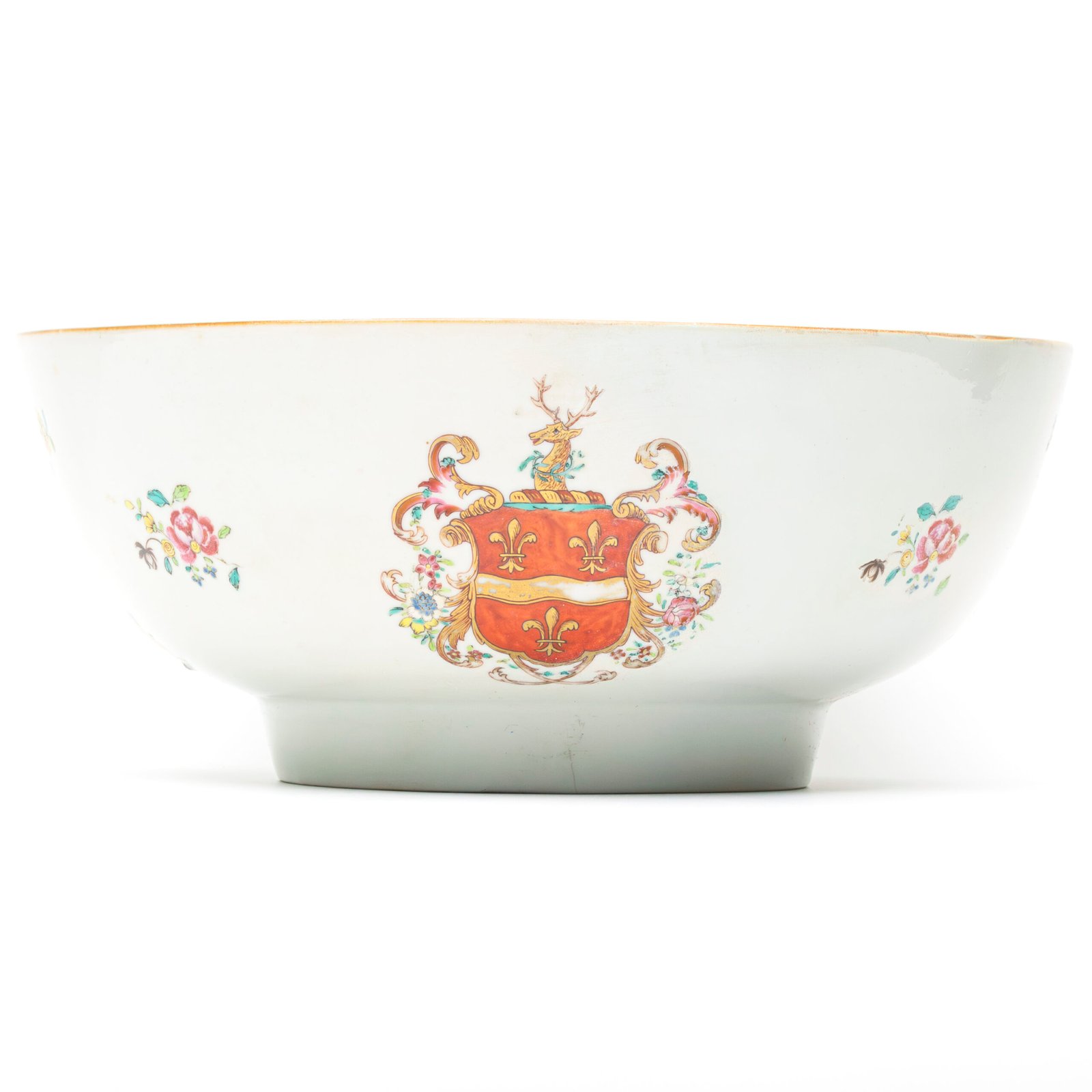
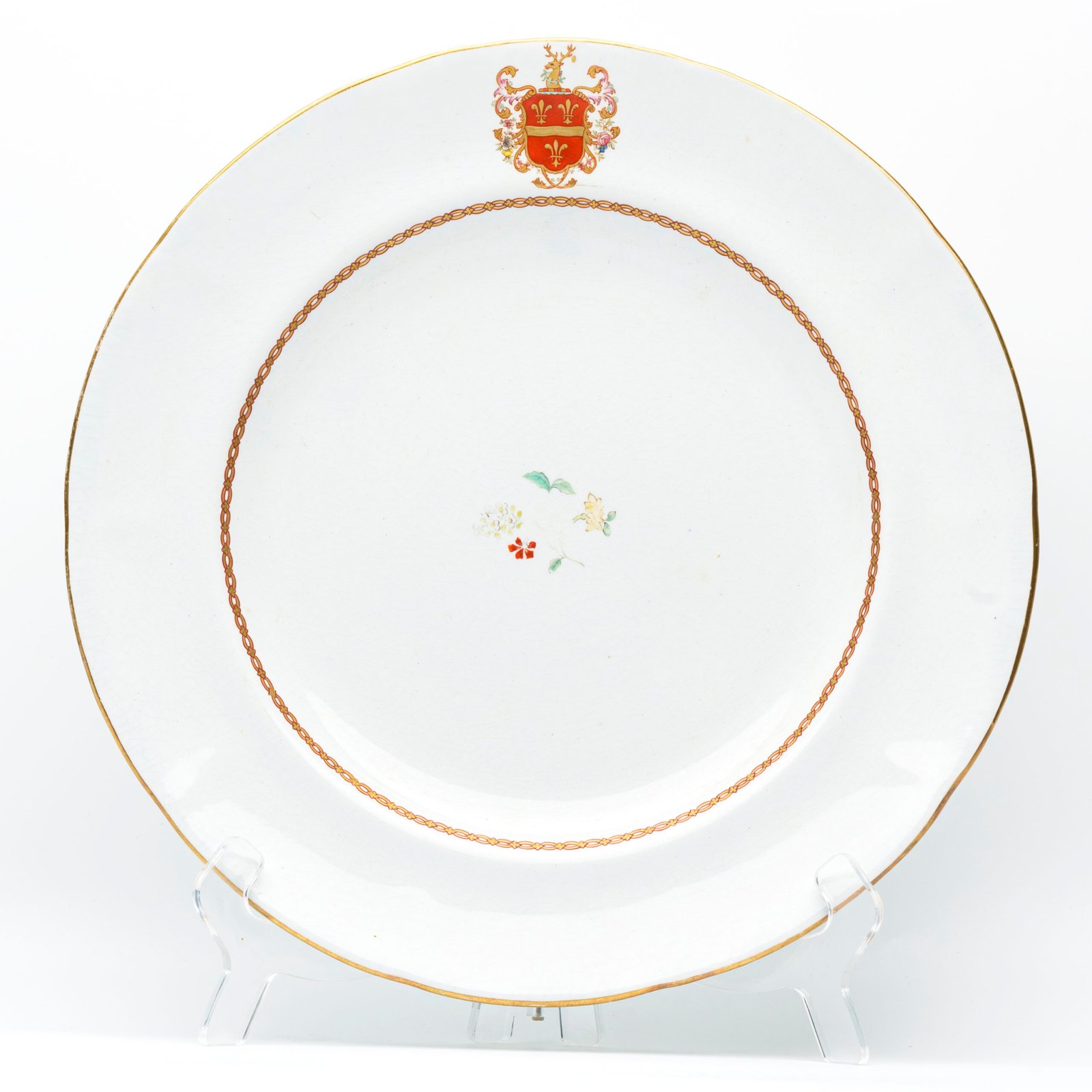
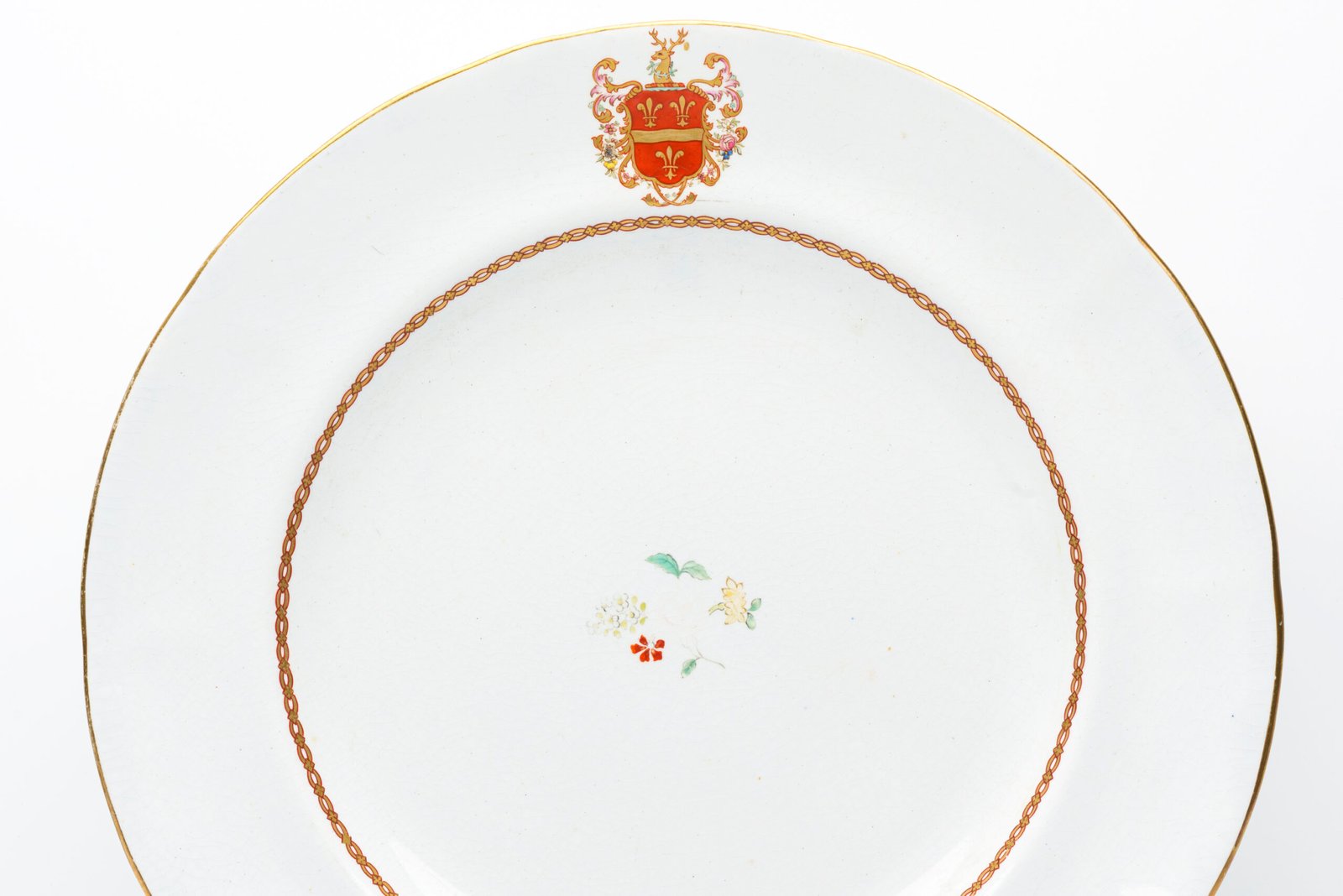
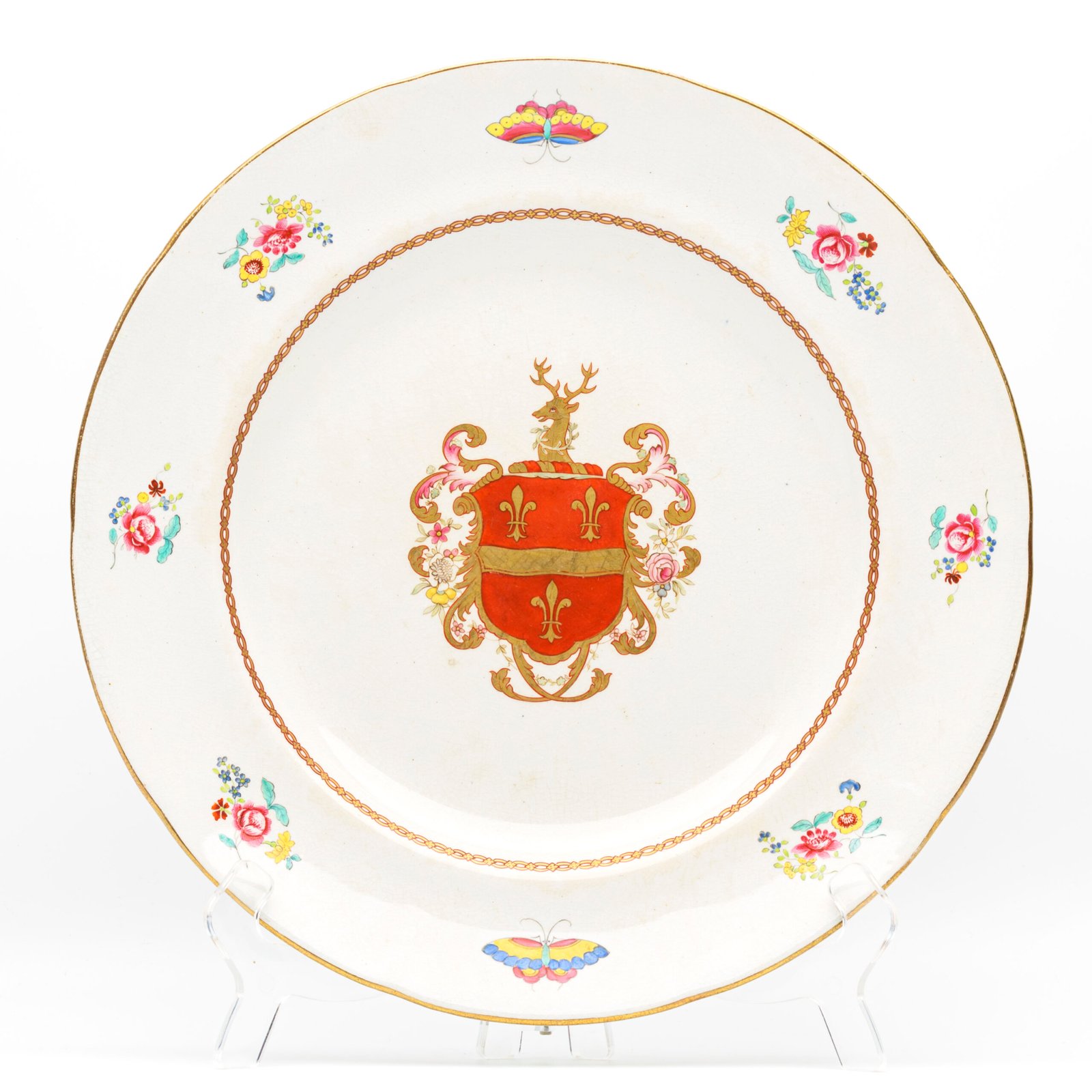
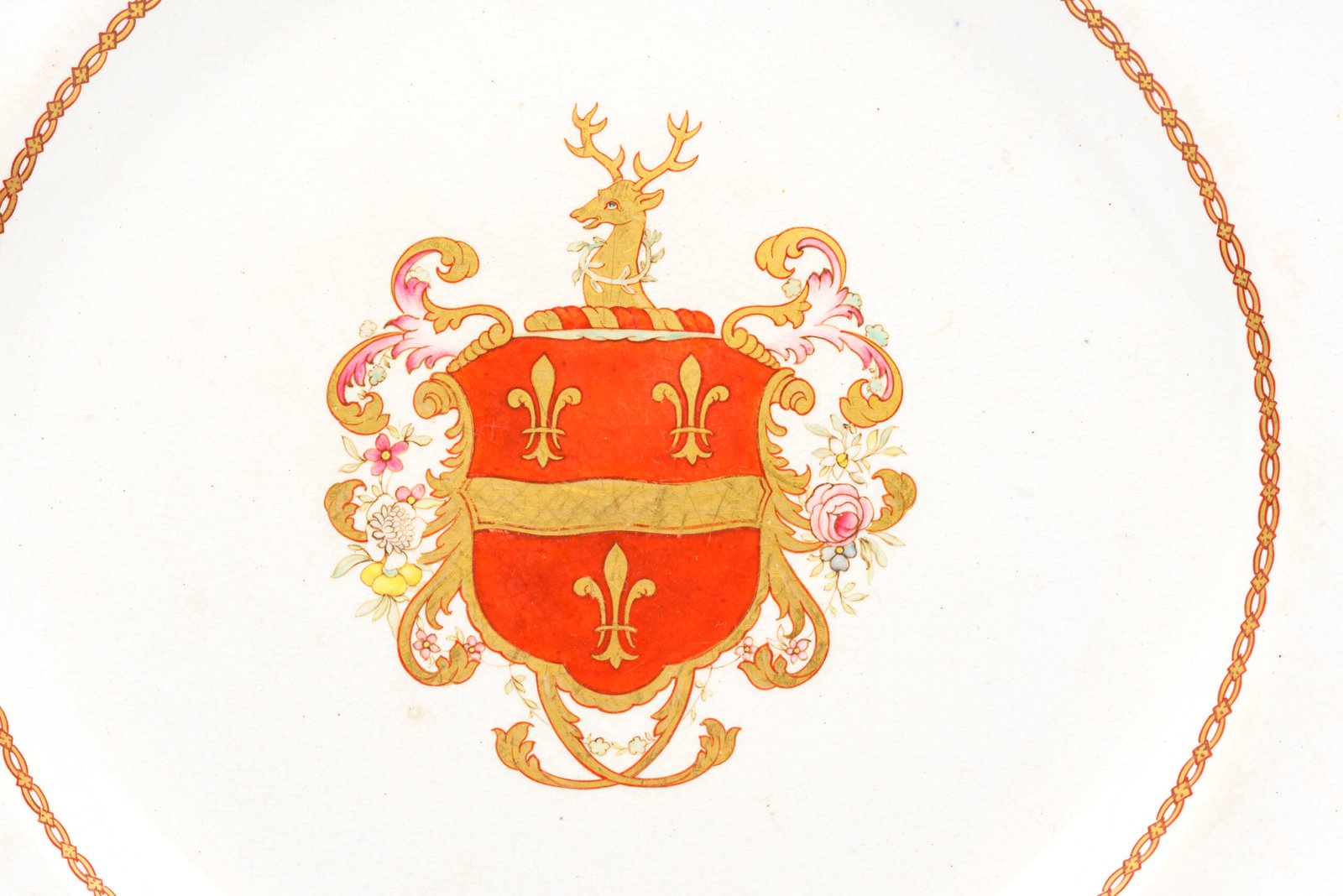
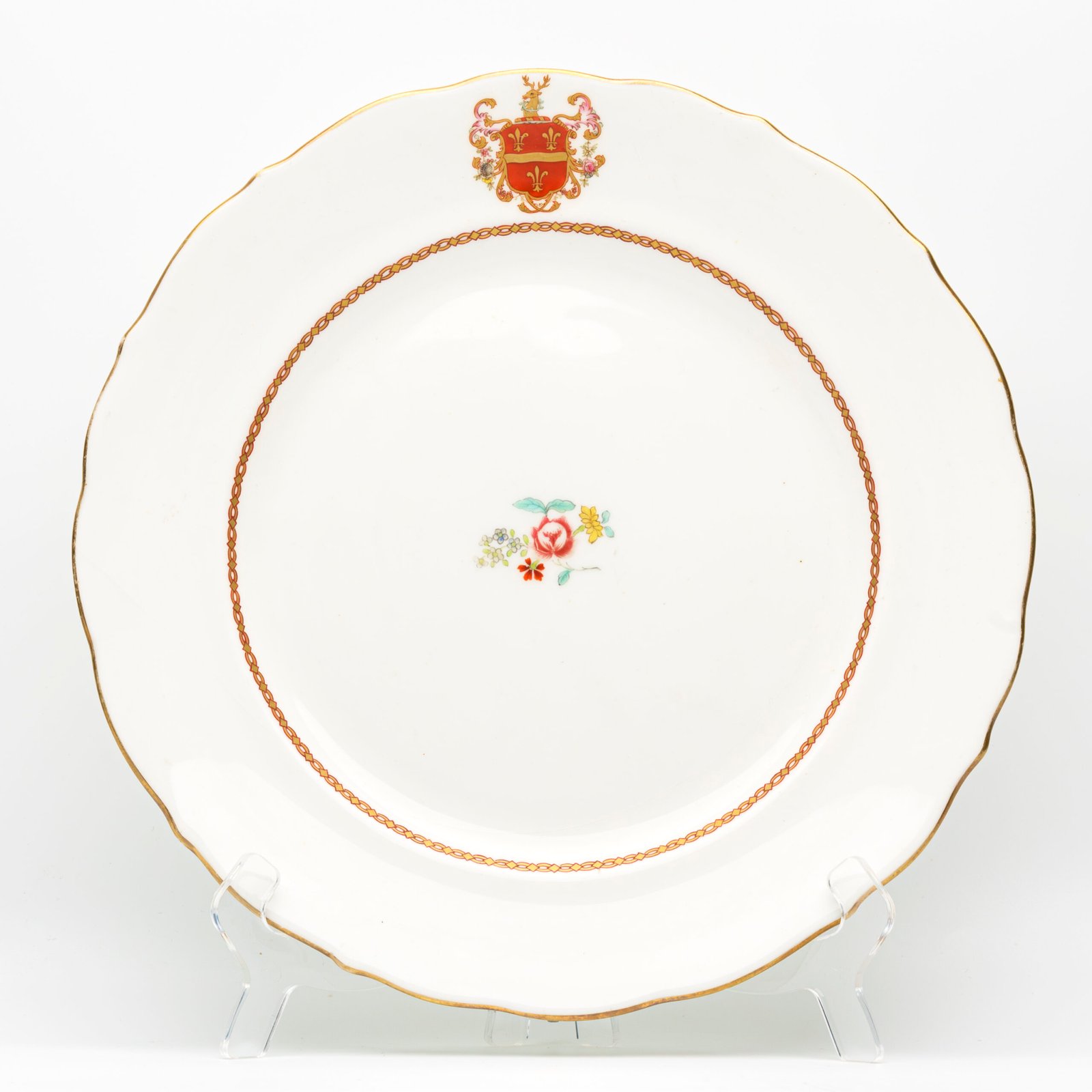
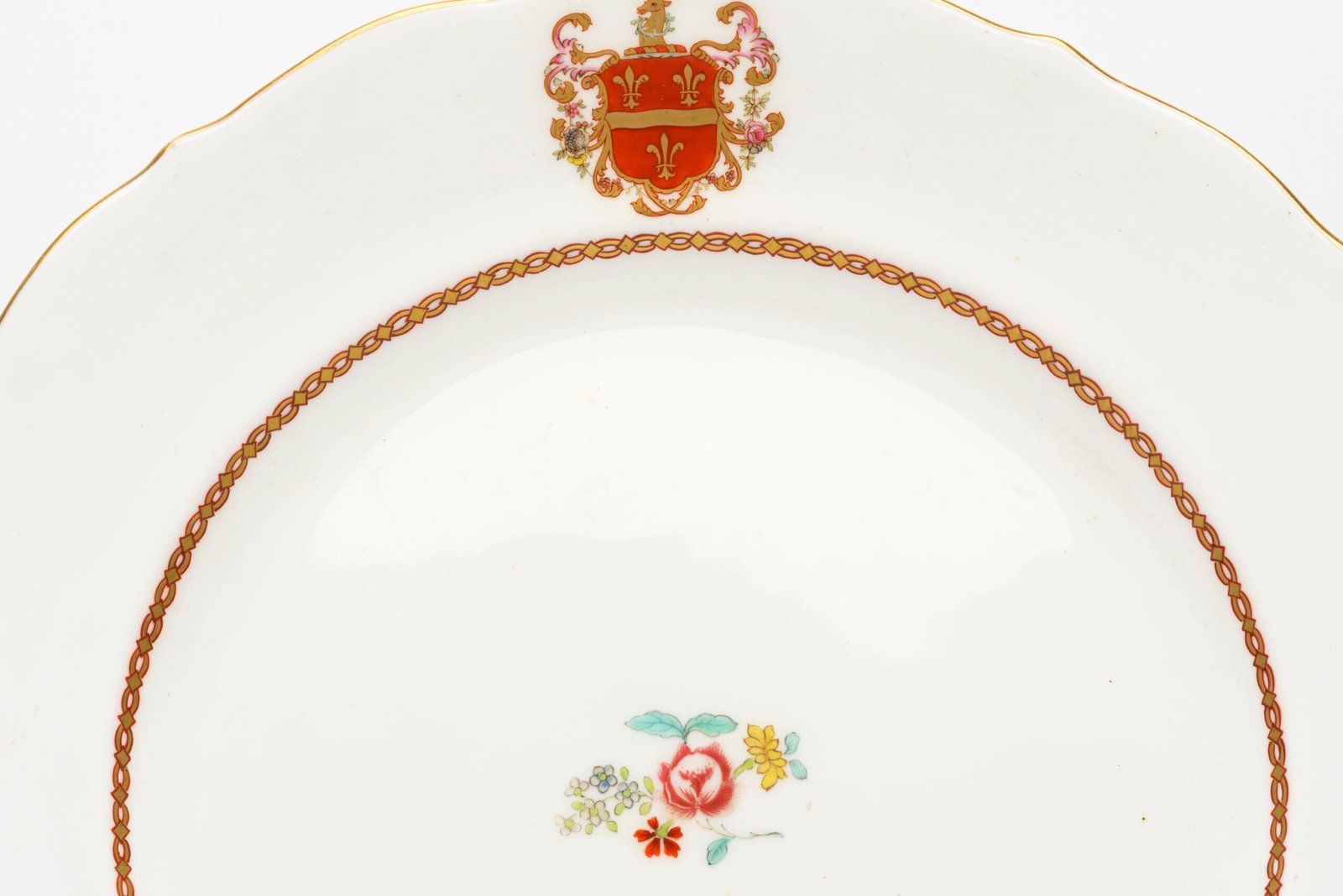
Armorial
Historical Overview
🌟 SECTION I — INTRODUCTION TO CHINESE ARMORIAL PORCELAIN
Chinese Armorial Porcelain — How to Read It
Beginner view:
Armorial porcelain is Chinese export porcelain decorated with European coats of arms. These pieces were custom-ordered by wealthy families and institutions as symbols of identity, status, and global reach.
For beginners, focus on:
Armorial porcelain is Chinese export porcelain decorated with European coats of arms. These pieces were custom-ordered by wealthy families and institutions as symbols of identity, status, and global reach.
For beginners, focus on:
- Is the coat of arms hand-painted (not printed)?
- Does the style match an 18th-century European taste?
- Is the porcelain Chinese rather than European?
Expert view:
Armorial porcelain should be read as a cross-cultural document. Analyse the relationship between European heraldic source material and Canton workshop interpretation.
Experts prioritise:
Armorial porcelain should be read as a cross-cultural document. Analyse the relationship between European heraldic source material and Canton workshop interpretation.
Experts prioritise:
- Enamel palette and border logic consistent with date range
- Heraldic accuracy vs workshop simplification or error
- Evidence of marriage arms, quartering, or augmentation
- Form compatibility with service type and period
- Whether the piece is original, replacement, or later revival
What Is Armorial Porcelain?
Armorial porcelain is Chinese export ware decorated with a European coat of arms, crest, or heraldic device.
These objects were painted in China—mainly in Jingdezhen and Canton—specifically for Western clients between c.1680 and 1820.
They are the most personal category of export porcelain, because each piece was created for a named family, a merchant, or occasionally an entire institution.
Every plate, bowl, or teapot becomes a small historical document linking Chinese craftsmanship with European identity and social status.
Attribution Confidence — Chinese Armorial Porcelain
67%
⬅️ Drag to explore confidence ➡️
Baseline attribution. The piece aligns broadly with known armorial production, but some elements remain unresolved.
- General armorial format present
- Some stylistic or heraldic ambiguity
Confidence reflects the convergence of multiple indicators rather than a single decisive factor.
Why Did Families Order It?
Armorial porcelain served several purposes:
- Display of lineage and social position
- Commemoration of marriages, where two coats were combined on one shield
- Celebration of professional rank, especially among merchants, ship captains, and officials
- Luxury dining and entertaining, matching the European silver and heraldic tableware of the time
- Connection with the China Trade, showing one’s participation in global commerce
In essence, armorial porcelain was both art and identity—a fusion of European heraldry and Chinese aesthetic skill.
How the Ordering Process Worked
Orders were placed through supercargoes, the official representatives of European trading companies stationed in Canton.
The typical process:
- A family sent a bookplate, drawing, or wax seal showing their coat of arms.
- The supercargo delivered it to Chinese enamelers.
- Chinese painters interpreted the design, sometimes faithfully, sometimes creatively.
- The porcelain pieces were produced in Jingdezhen, shipped to Canton, then transported to Europe.
Because heraldry was unfamiliar to Chinese decorators, misinterpretations were common—one of the most fascinating aspects of collecting today.
How Chinese Artists Interpreted Heraldry
Chinese artists worked from small black-and-white prints or sketches, with no access to colour heraldic rules.
This frequently resulted in:
- Incorrect colours (“azure” interpreted as black, “gules” as brown)
- Simplified animals
- Creative ornamentation added by the painter
- Mirror-reversed shields (from copying engravings)
- Arms placed on unexpected backgrounds
Far from being flaws, these variations give armorial porcelain its unique charm and help specialists determine dating and authenticity.
Why Armorial Porcelain Matters Today
Armorial porcelain is important because it:
- Preserves the names, histories, and symbols of families active in the China Trade
- Represents one of the earliest forms of international bespoke luxury
- Bridges two artistic traditions—European heraldry and Chinese enamel painting
- Helps historians reconstruct trade routes, personal networks, and social trends
- Remains a vibrant collecting field with strong museum representation
For collectors, armorial porcelain offers beauty, genealogy, and history—all in a single object.owed Chinese porcelain to dominate global trade in the centuries to come.
✅ SECTION A — Reading Coats of Arms (Beginner-Friendly Guide for Collectors)
⭐ 1. What Is a Coat of Arms?
A coat of arms is a visual identity system developed in medieval Europe.
On Chinese export porcelain, it became a way for families—and later merchants and officers—to express lineage, status, and connection to the East India trade.
Each armorial service was painted in Canton by Chinese artists who followed European drawings sent from home. Their interpretations were often brilliant, occasionally imperfect, and today extremely collectible.
⭐ 2. The Structure of a Coat of Arms
The Shield
The main part of the arms. It carries the principal symbols (called charges).
Shapes differ slightly depending on period, but Chinese painters generally reproduced a rounded baroque form.
The Crest
A symbol placed above the shield, usually on a small torse (twisted cloth).
Chinese painters often simplified crests due to unclear drawings.
Supporters
Figures holding the shield—lions, unicorns, dragons, birds, etc.
Only noble families were entitled to use supporters, which helps dating and attribution.
Motto
A short phrase beneath the shield.
Often painted in tiny calligraphy by Canton artists—sometimes misspelled or mirrored.
Coronet / Helmet
Indicates rank:
- Baron
- Viscount
- Earl
- Marquess
- Duke
Chinese artists copied these carefully, but mistakes occur, especially in complex coronets.
⭐ 3. Heraldic Colours (Tinctures)
European heraldry uses a very strict colour code:
| Heraldic Term | Meaning | Canton Interpretation |
|---|---|---|
| Argent | silver/white | painted as plain white (porcelain ground) |
| Or | gold | gilding |
| Gules | red | iron-red enamel |
| Azure | blue | cobalt blue or blue enamel |
| Vert | green | green enamel |
| Sable | black | manganese/ink outlines |
Chinese painters often relied on written labels (“red”, “blue”, “green”) supplied on drawings.
⭐ 4. Common Heraldic Symbols (Charges)
Animals
- Lions (strength, nobility)
- Birds: eagles, martlets, doves
- Stags and deer
- Mythical beasts (griffins, dragons)
Geometric shapes
- Chevrons
- Fesses (horizontal bands)
- Pallets (vertical stripes)
- Bordures (borders)
Objects
- Stars, crescents, crosses
- Swords, anchors, ships
- Flowers and plants
Each was meaningful to the family—identity, alliances, or achievements.
⭐ 5. How to Interpret Arms on Chinese Porcelain
Here is your website-friendly explanation:
(1) Identify the main charges
Look for the boldest shapes: chevrons, animals, crosses.
(2) Check the tincture substitution
If colours look reversed or simplified → likely due to unclear instructions.
(3) Look at the crest above the shield
Unique shapes often lead to exact family identification.
(4) Examine supporters and coronet
Supporters = nobility → dating often later (c. 1735–1800).
(5) Study motto and scroll
Misspellings or reversed lettering are common but add charm.
🔍 Why Do Mistakes Occur?
Canton painters interpreted European drawings that were often faint, reversed, or labelled in handwriting. Misread colours, reversed crests, or simplified supporters are charming evidence of this cross-cultural process.
Canton painters interpreted European drawings that were often faint, reversed, or labelled in handwriting. Misread colours, reversed crests, or simplified supporters are charming evidence of this cross-cultural process.
⭐ 6. Typical Painting Characteristics in Canton
✔️ Mirror-reversal mistakes
The painter reversed images due to transferring drawings.
✔️ Misread labels
“Green” painted as “red” because the label was unclear.
✔️ Over-ornamentation
Chinese artists sometimes added extra floral scrolls not in the original design.
✔️ Simplified supporters
Especially with complex animals (griffins, unicorns).
These quirks are not defects—they are part of what makes Chinese armorial porcelain unique.
✅Armorial Style Classification A–Z
🛡️ Why Armorial Porcelain Matters
Each service was a personalised order bearing a family’s identity. Painted in Canton from European drawings, these objects preserve stories of trade, travel, and ancestry.
Each service was a personalised order bearing a family’s identity. Painted in Canton from European drawings, these objects preserve stories of trade, travel, and ancestry.
🔵 A — Early Underglaze Blue (Kangxi–Yongzheng, c. 1690–1730)
- Arms painted in cobalt blue only
- Crisp, elegant line work
- Borders: diaper, floral sprays, key-fret
- Among the earliest armorial wares exported
Why it matters:
Represents the beginning of the European–Chinese heraldic connection.
🔴 B — Chinese Imari (Kangxi–early Qianlong)
- Iron-red, cobalt blue, and gilding
- Vibrant and decorative
- Popular among Dutch and British merchants
🟢 C — Famille Verte (c. 1710–1735)
- Strong greens, yellows, aubergines
- Distinctive early 18th-century taste
- Often features floral borders
🔥 D — Rouge-de-Fer & Gold
- Rich iron-red grounds
- Heavy gilding
- Very luxurious and popular c. 1725–1745
You can continue with E → Z anytime — I can finish them all for you.
🔵 E — European Baroque Cartouches (c. 1725–1750)
Arms framed in scrolling baroque panels, often asymmetric and richly gilded.
Chinese painters borrowed motifs from European engravings sent with the order.
Features:
- Heavy scrolls and shells
- Deep iron-red & gold highlights
- Often paired with floral sprays
Dating clue: early to mid-Qianlong, but inspired by earlier European fashion.
🟣 F — Rococo Shell & Featherwork (c. 1740–1765)
A more playful evolution of Style E.
Light, swirling frames, echoing European silverware.
Features:
- Rococo “C-scrolls”
- Feathery tips, pink and green tones
- Light famille rose palette
Dating clue: strong indicator of c. 1750–1765.
🔶 G — Floral Garlands & Pastoral Borders (c. 1740–1770)
Arms encircled with naturalistic roses, peonies, carnations, arranged like festoons.
Features:
- Flower chains
- Soft famille rose shading
- Sometimes Europeanised pastoral motifs
Dating clue: very common in mid-Qianlong commissions.
🔴 H — Ornate Gilt Frames (c. 1735–1765)
Emphasis on gilding, often with raised dots and stippling.
Features:
- Heavy gold
- Thick frame around arms
- Minimal surrounding decoration
Dating clue: indicates higher-end services of the mid-18th century.
🟢 I — Grisaille Armorials (c. 1740–1790)
Decoration executed in monochrome black/sepia, resembling engravings.
Features:
- Arms rendered in grisaille
- Sometimes with small famille rose touches
- Highly refined draughtsmanship
Dating clue: mid-late Qianlong, often inspired by European prints.
🟡 J — European Scene Panels (c. 1740–1775)
Arms combined with vignettes of European landscapes, ruins, shepherd scenes.
Features:
- Alternating panels around rim
- Arms in central medallion
- Soft, atmospheric painting
Dating clue: peak around 1755–1770.
🔵 K — Border-Paneled Armorials (c. 1735–1780)
The rim is divided into sections (panels) containing repeated motifs.
Features:
- Flowers, mandarin designs, diaper grounds
- Arms sit inside plain or framed center
- Highly decorative
Dating clue: extremely common mid-century.
🟣 L — Trellis & Diaper Borders (c. 1720–1760)
Geometric patterning around the rim.
Features:
- Honeycomb, lattice, trellis motifs
- Often in turquoise or iron-red
- Can indicate early famille rose period
Dating clue: popularity peaks c. 1730–1750.
🔶 M — Spearhead Borders (c. 1745–1765)
One of the most iconic Chinese export borders.
Features:
- Sharp alternating triangles
- Usually blue, red, or black
- Arms placed simply inside
Dating clue: strongly mid-18th century.
🔴 N — Chain Borders (c. 1750–1780)
Linked rings or ovals forming a perimeter.
Features:
- Black, sepia, or light blue chains
- Arms often small & neat
- Elegant neoclassical simplicity emerging
Dating clue: transitional between rococo and neoclassical.
🟢 O — Fitzhugh-Influenced Armorials (c. 1770–1800)
Dense floral and diaper patterns, adapted from the Fitzhugh export pattern.
Features:
- Rich blue or famille rose border
- Thick corner motifs
- Arms small within large medallion
Dating clue: classic late-Qianlong patterning.
🟡 P — Large Floral Bouquet Borders (c. 1760–1800)
Big European-style flower clusters on rims.
Features:
- Loose, naturalistic flowers
- Softer colours
- Arms remain central focus
Dating clue: neoclassical period.
🔵 Q — Wide Enamel Bands (c. 1780–1810)
Arms framed within broad coloured rims (pink, green, blue, sepia).
Features:
- Neoclassical architecture influence
- Solid colour grounds
- Minimal extra ornament
Dating clue: strong late Qianlong to early Jiaqing signal.
🟣 R — Pink-Ground & Ruby-Ground Armorials (c. 1740–1770)
Bright enamel grounds around rim or center.
Features:
- Pink, ruby, purple backgrounds
- Arms in contrasting panel
- Luxurious famille rose palette
Dating clue: high-status mid-century orders.
🔶 S — Central Scene Armorials (c. 1740–1780)
A unique style where the arms appear inside a larger scenic composition.
Features:
- Landscape or figure scenes
- Arms integrated into architecture
- Or placed as a “coat” on a vessel or scroll
Dating clue: artistic Qianlong-era services.
🔴 T — Mandarin Palette Armorials (c. 1790–1820)
Arms paired with late Canton mandarin figures and famille rose scenes.
Features:
- Strong 19th-century palette
- Panelled figural scenes
- Arms often small
Dating clue: late export period.
🟢 U — Blue-Enamel Armorials (c. 1760–1800)
Not blue-and-white, but blue enamel famille rose armorials.
Features:
- Soft blue rim wash
- Internal white cartouche for arms
- Typical of high-end Qianlong wares
Dating clue: fashionable among English patrons.
🟡 V — Simplified Provincial Armorials (c. 1800–1850)
Often late Canton work with simplified shields, light palette, and weaker gilding.
Features:
- Very plain arms
- Thinner enamel
- Occasionally inaccurate heraldry
Dating clue: marks decline after 1800.
🔵 W — Replacement Pieces (c. 1750–1900)
Single plates or bowls ordered later to repair broken services.
Features:
- Do not match original borders exactly
- Arms may be correct but painted differently
- Useful for dating family history
Dating clue: variable — sometimes decades after original commission.
🟣 X — European-Made Armorial Replacements (c. 1780–1900)
Produced by Spode, Worcester, Samson, etc.
Included here for comparison.
Features:
- Different porcelain body
- European enamels & gilding style
- Often copies earlier Qing-style armorials
Dating clue: post-Qianlong, into Victorian period.
🔶 Y — 19th-Century Revival Armorials (c. 1850–1900)
Late-century revival pieces produced mainly in Canton or Europe.
Features:
- Heavier colours
- Simplified arms
- Not true Qing dynasty commissions
Dating clue: popular with Victorian collectors.
🔴 Z — 20th-Century Reproductions (c. 1900–1950+)
Included for educational completeness.
Features:
- Arms often invented
- Modern enamels
- Very different feel from 18th-century originals
Dating clue: post-1900; not antique but historically interesting.
✅ Collector Timeline
🎨 How Heraldic Colours Work
European heraldry uses a strict colour code. Chinese artists translated these into enamel paints—sometimes faithfully, sometimes creatively—making each armorial service unique.
European heraldry uses a strict colour code. Chinese artists translated these into enamel paints—sometimes faithfully, sometimes creatively—making each armorial service unique.
📘 Timeline of Chinese Armorial Porcelain (1680–1820)
1680–1700 – The First Experiments
- Small, rare commissions
- Blue-and-white only
- Simple shields without supporters
1700–1725 – Expansion of Trade
- More families commissioning services
- Introduction of Imari palettes
- Early famille verte borders
1725–1745 – The Golden Age
- Explosion of commissions
- Rouge-de-fer, rich gilding
- Large dinner services become fashionable
- Complex arms appear (crests, supporters)
1745–1770 – Technical Refinement
- Canton workshops perfect European style
- Famille rose becomes dominant
- Border styles diversify (diaper, spearhead, Fitzhugh)
1770–1800 – Late Classic Period
- Softening palettes
- More naturalistic flowers
- Qianlong blue-and-white armorials flourish
- Strong commercial trade through East India Companies
1800–1820 – Decline & Transition
- Fewer services ordered
- Taste shifts in Europe
- Start of 19th-century revival pieces
⏳ How to Estimate the Date
Look at the palette, border style, shape of the shield, and quality of gilding. These elements changed in recognisable phases from Kangxi to Jiaqing and help narrow down a service to within 5–10 years.
Look at the palette, border style, shape of the shield, and quality of gilding. These elements changed in recognisable phases from Kangxi to Jiaqing and help narrow down a service to within 5–10 years.
Objects from this Period or Antique Examples
Sort by:
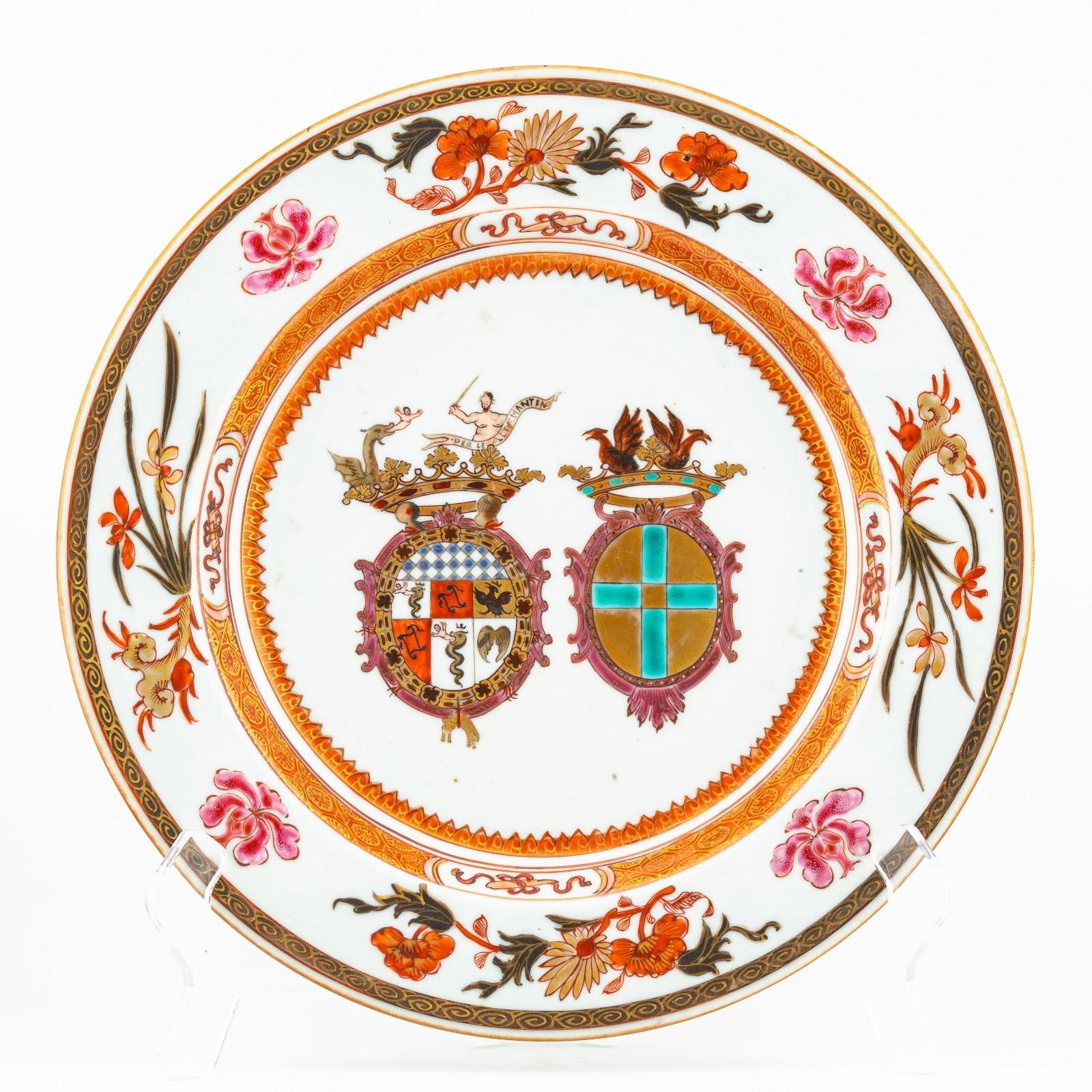
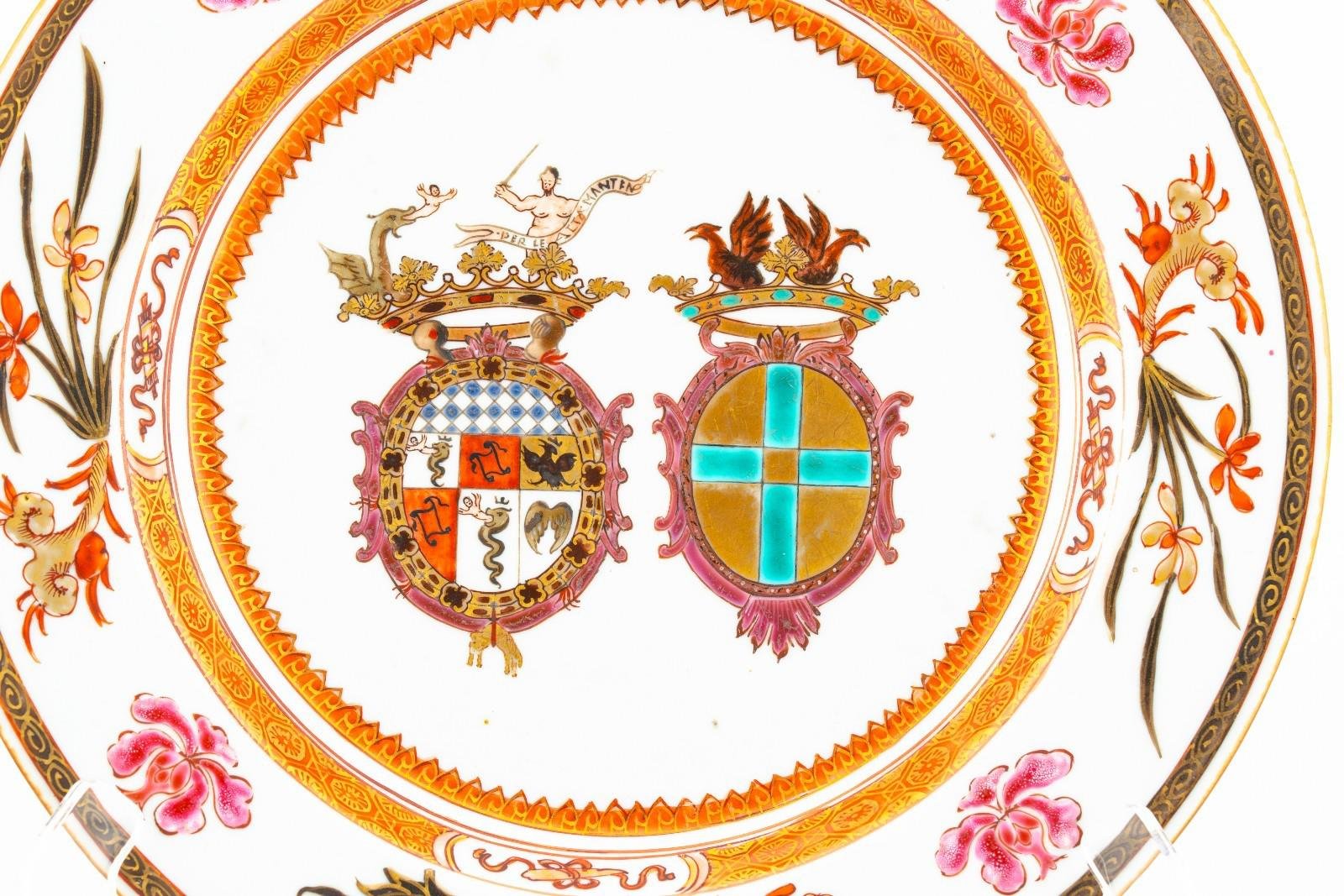
Chinese Yongzheng Armorial Visconti Cusani Plate Italian Market Famille Rose 18t
🌟 Product Details
🆔 Inventory Code INV3609
Ⓜ️ Material Chinese Export Porcelain
🏳...