
Doucai
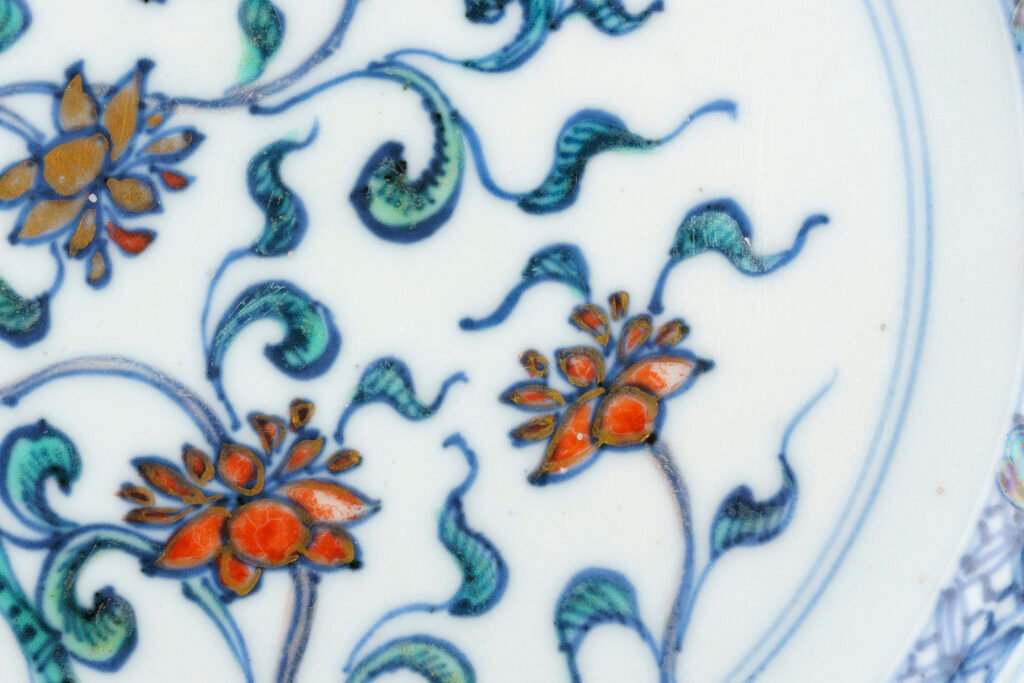
Doucai (斗彩)
Doucai is a Chinese porcelain-decorating technique that combines underglaze cobalt blue with coloured overglaze enamels. The term is commonly translated as “joined colours,” “fitted colours” or “contrasting colours,” referring to the way the two types of decoration work together in a single design.
How doucai was made
Producing doucai required at least two firings. First, cobalt blue was painted directly onto the unfired porcelain body. It could be used for outlines, washes or complete blue elements of the design. The vessel was then covered with a transparent glaze and fired at a high temperature.
After this first firing, enamels such as red, green, yellow and aubergine were applied over the glaze. These colours were placed within or beside the blue decoration before the porcelain received a second firing at a substantially lower temperature.
The completed decoration therefore occupies two levels: cobalt blue beneath the transparent glaze and coloured enamels on its surface. This technically demanding process allowed the blue and enamel colours to form one carefully coordinated composition. The Metropolitan Museum of Art describes the two-stage process on its Chenghua chicken cup.
Development during the Ming dynasty
The technical foundations of doucai appeared at the imperial kilns of Jingdezhen during the early Ming dynasty. The style reached its most celebrated form during the Chenghua reign, from 1465 to 1487.
Chenghua doucai porcelain is particularly associated with small, finely potted cups, bowls, stem cups and jars. Its decoration is usually delicate in scale, with restrained enamels, softly painted cobalt and generous areas of undecorated white porcelain.
The best-known examples are the Chenghua “chicken cups,” decorated with cockerels, hens and chicks among rocks and flowering plants. Their imagery is generally associated with family life, care for the young and the continuation of the family line.
Earlier technical precedents
Doucai did not emerge without earlier experiments in combining differently fired pigments. Red-and-green wares known as honglvcai were made in northern China during the Jin dynasty (1115–1234).
Scientific analysis of a honglvcai sherd from the Cizhou kiln system identified high-fired black underglaze decoration combined with low-fired red and green overglaze colours. The researchers described this as a possible technical prototype for later doucai. However, these Jin wares are not conventionally classified as true doucai because they use iron-rich black decoration rather than the cobalt-blue system associated with Ming imperial porcelain. Research paper and DOI.
Later Ming and Qing doucai
Imperial doucai production declined after the Chenghua reign, although the technique continued in smaller quantities during later Ming periods. Jiajing and Wanli examples frequently adapted earlier designs but could be larger and more strongly coloured than their Chenghua models.
Doucai experienced an important revival during the Qing dynasty, particularly under the Kangxi, Yongzheng and Qianlong emperors. Qing potters reproduced celebrated Ming patterns while also creating new compositions, forms and enamel combinations.
Many later pieces carry apocryphal Chenghua reign marks as a tribute to the admired earlier porcelain. A Chenghua mark therefore does not, by itself, establish that a piece was made during the fifteenth century.
Marks
Original Chenghua doucai commonly bears a six-character Chenghua reign mark in underglaze blue. An unusual group of small jars carries the single character tian (天), meaning “heaven.” This mark is closely associated with Chenghua-period jars decorated in doucai. British Museum example.
Later Ming, Qing and modern copies may reproduce Chenghua marks. Dating must also consider the porcelain body, glaze, foot construction, cobalt, enamel colours, painting style and evidence of wear.
Doucai and wucai
Doucai and wucai both combine underglaze blue with overglaze colours, and the distinction is not always absolute. In classic doucai, the blue and coloured enamels are closely integrated: enamel colours are fitted into or coordinated with the underglaze design.
Wucai decoration is generally bolder, with larger and more independent areas of overglaze colour. Underglaze blue usually functions as one colour within the wider composition rather than as the underlying framework for most of it.
Doucai should also be distinguished from famille rose, which uses a later palette of predominantly opaque overglaze enamels capable of softer shading and a much wider range of pinks.
Identifying doucai
On genuine doucai, the cobalt blue is protected beneath the transparent glaze and should feel smooth. The overglaze enamels sit on the glazed surface, may be slightly raised and are more vulnerable to rubbing, scratching and chemical cleaning.
Collectors should look for:
- A clear relationship between the underglaze blue and enamel colours.
- Blue decoration visible beneath the transparent glaze.
- Enamels applied above the glaze rather than mixed into it.
- Natural surface wear consistent with the object’s proposed age.
- Appropriate porcelain body, foot, glaze and mark for the stated period.
Neither colour nor reign mark should be used alone to authenticate or date a piece.
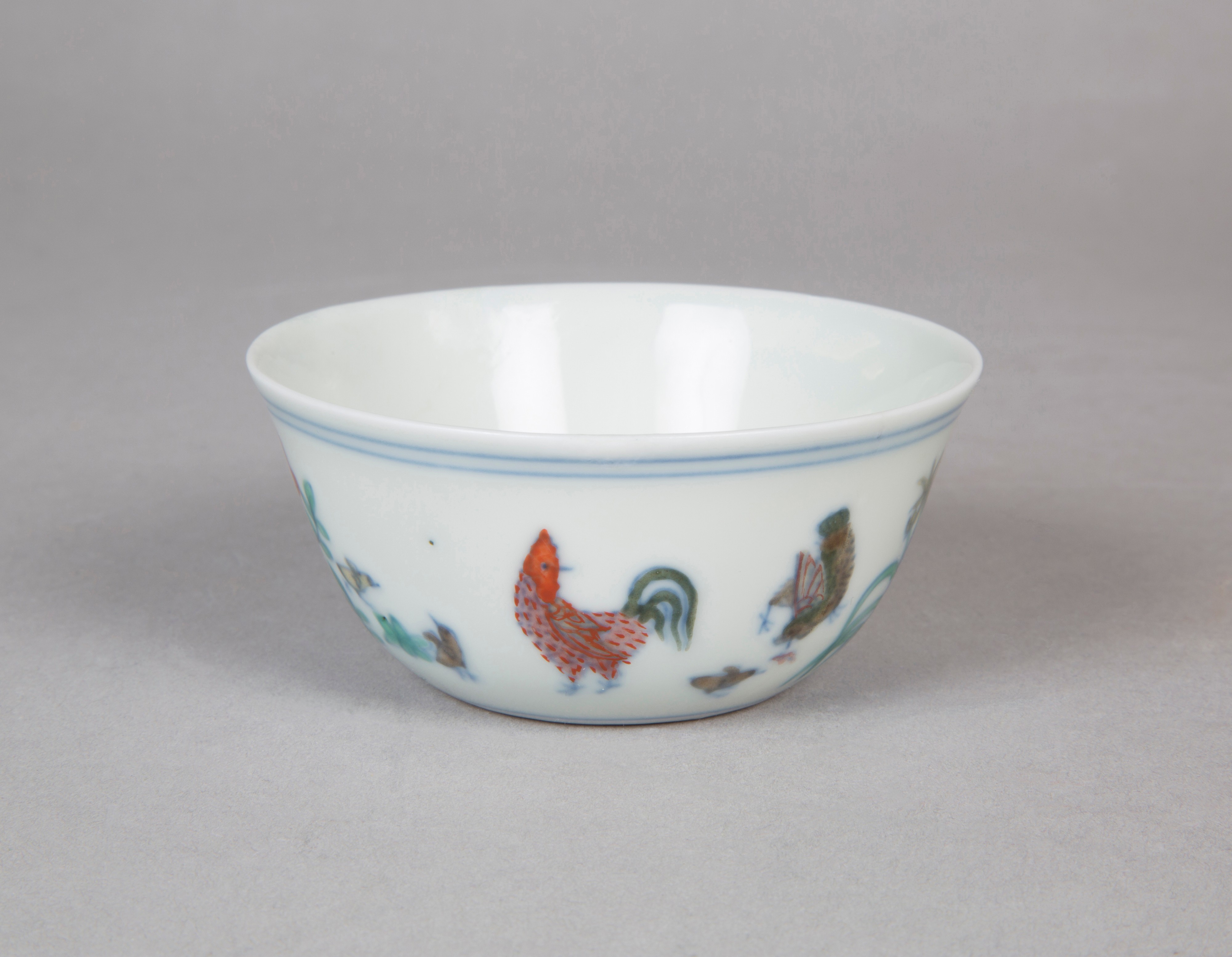
Doucai chicken cup, China, Chenghua mark and period (1465–1487). Porcelain painted in underglaze cobalt blue and overglaze coloured enamels, Jingdezhen ware. The Metropolitan Museum of Art, object 1987.85. Public Domain.