
Coral
Coral
In Chinese art, the word coral may describe either natural marine coral used as a carving material or the coral-red enamel applied to porcelain. Although visually related, these are entirely different materials and should not be confused.
Natural coral in Chinese art
Natural coral is an organic material formed from the calcium-carbonate skeletons of marine animals. Red and pink varieties were especially valued in China and entered the country through long-distance maritime trade.
Coral became closely associated with wealth, longevity and high social status. Its branching form was compared with a tree, giving it auspicious associations with enduring life. Red coral was also used in Qing court dress, jewellery and official hat finials, where the material could indicate elevated rank.
During the Qing dynasty (1644–1911), coral was carved into beads, pendants, court accessories, small ornaments, snuff-bottle stoppers and, more rarely, complete snuff bottles. Imperially commissioned lapidary work was undertaken in palace workshops and in established carving centres such as Suzhou and Yangzhou.
Whole coral snuff bottles are uncommon because sufficiently thick branches were difficult to obtain. Natural fissures, cavities and variations in colour were normal features of the material. Qing craftsmen sometimes joined separate sections or inserted matching pieces of coral into flaws during manufacture. Such carefully fitted additions are not necessarily later repairs.
Coral-red porcelain
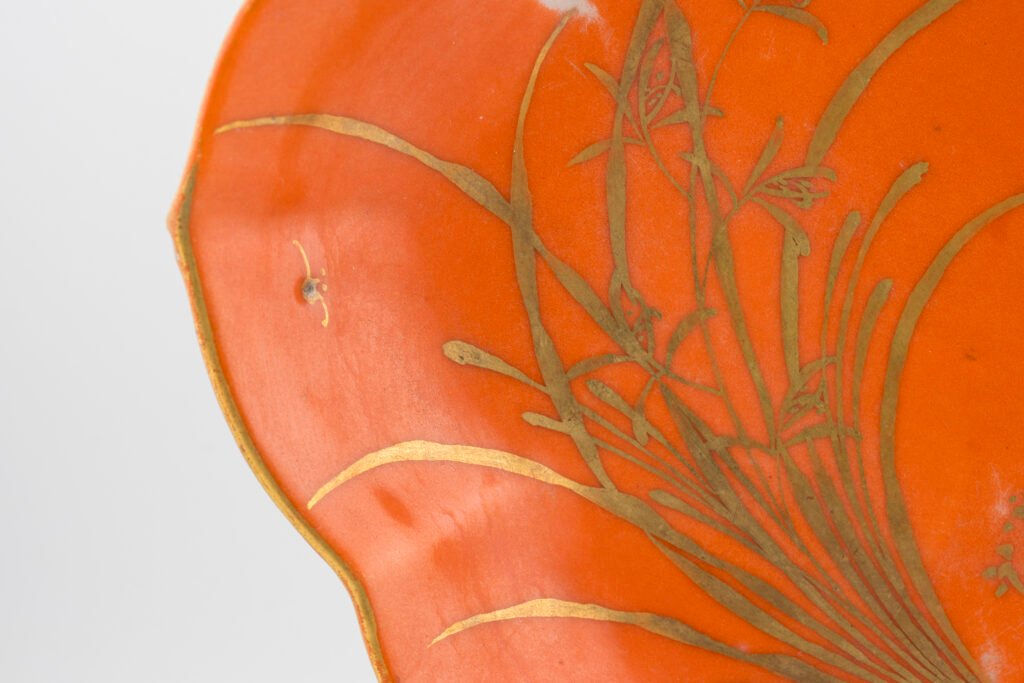
Coral red, known in Chinese as shanhu hong (珊瑚红), is a ceramic colour intended to resemble polished red coral. It contains no natural coral.
The colour was normally produced with an iron-based pigment applied over a previously glazed and fired porcelain body. The decorated object was then fired again at a lower temperature. For this reason, many surfaces described commercially as “coral-red glaze” are more accurately classified as iron-red overglaze enamel.
Coral red ranges from bright reddish orange and salmon red to deeper brick or crimson tones. The final appearance depends on the preparation of the pigment, the thickness of the enamel and the conditions of the second firing. An evenly coloured surface required considerable technical control.
Refined coral-red grounds became prominent at Jingdezhen during the Qing dynasty. They were used as complete monochrome coverings and as coloured backgrounds for famille rose decoration, floral reserves, scrolling foliage and auspicious motifs. Fine examples occur from the Kangxi period (1662–1722) onwards, with particularly accomplished wares produced during the Yongzheng and Qianlong reigns. Production continued throughout the nineteenth century.
Identification
Natural coral and coral-red porcelain can usually be distinguished immediately:
- Natural coral is a carved marine material. It may show fine growth lines, branching structure, small cavities and variations in colour.
- Coral-red porcelain has a ceramic body covered with a smooth iron-red enamel or glaze.
- On many porcelain pieces, the white body remains visible inside the vessel, beneath the foot or within reserved decorative panels.
- Natural coral has been imitated in glass, resin, dyed bone and reconstructed material. Identification should therefore rely on careful, non-destructive examination.
Care and legal considerations
Natural coral is softer and more chemically sensitive than porcelain. It should be protected from acids, perfume, household cleaning products, excessive heat and prolonged contact with water. Ultrasonic cleaning should be avoided.
Some precious-coral species are protected by international wildlife-trade regulations. The species, age, origin and supporting documentation should be checked before natural coral is bought, sold or transported across national borders. These restrictions do not apply to coral-red porcelain because its colour is produced from mineral pigments rather than coral.
Suggested caption: Coral snuff bottle with a boy flying a bird, China, Qing dynasty, Qianlong period (1736–1795). The Metropolitan Museum of Art, Public Domain.