
Cloisonné
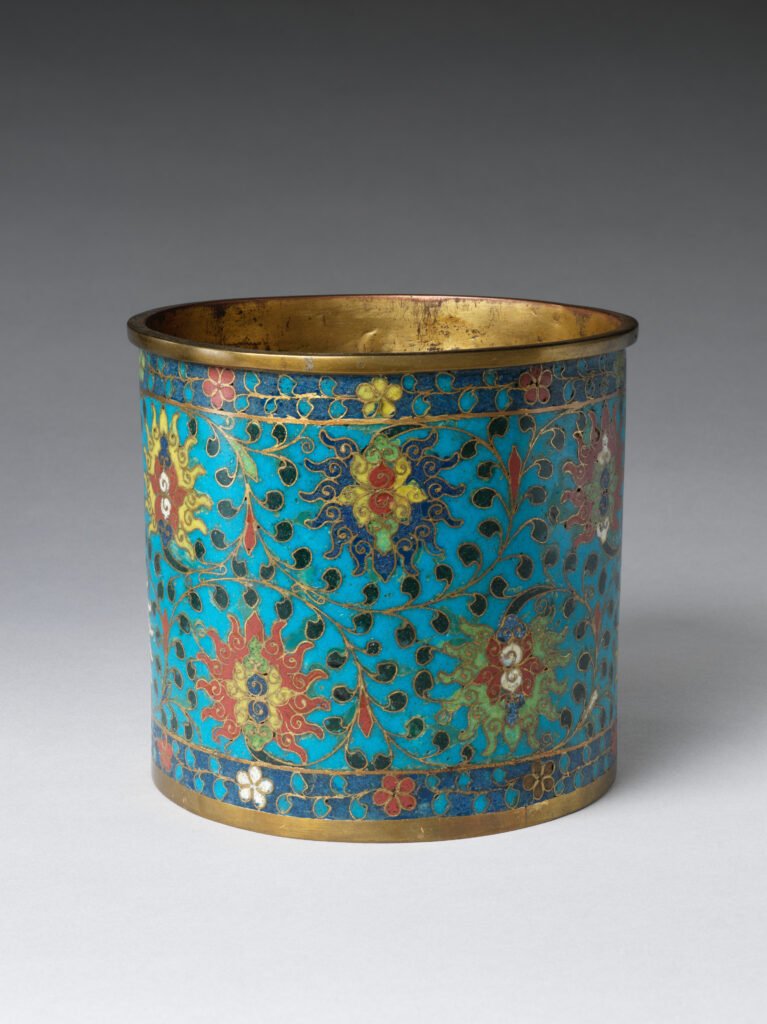
Cloisonné (Jingtailan 景泰蓝)
Cloisonné is a metal-enamelling technique in which coloured glass enamels are contained within patterns formed by fine metal wires. Chinese cloisonné is commonly called Jingtailan, or “Jingtai blue”, although the craft was established in China before the Jingtai reign.
What is cloisonné?
The word cloisonné comes from the French cloison, meaning a partition or compartment. Narrow wires are bent into the outlines of flowers, animals, figures, scrolls and geometric patterns, then attached to a copper or copper-alloy body. The spaces between the wires are known as cloisons.
Finely ground glass enamel, mixed into a paste, is placed inside these compartments. Each colour is normally prepared separately from glass combined with metallic colouring agents.
A more technically precise Chinese name is qiasi falang (掐丝珐琅), meaning wire-work enamel. Jingtailan (景泰蓝), literally “Jingtai blue”, became the better-known name because blue and turquoise grounds were strongly associated with Chinese cloisonné and with the reputation of the Jingtai period.
How Chinese cloisonné was made
Traditional production required several distinct stages:
- A vessel or object was formed from copper or another copper alloy.
- Fine metal wires were bent into the required design and fixed to the surface.
- Enamel paste was packed into the resulting cells.
- The piece was fired at approximately 800°C, melting the enamel into a glass-like surface.
- Because enamel contracts during firing, the cells usually required refilling and several additional firings.
- The surface was ground and polished until the enamel and wirework were level.
- Exposed metalwork, including rims, feet, handles and wires, was frequently gilded.
The finished decoration is therefore part of the object’s surface rather than paint applied over it. The Metropolitan Museum of Art illustrates this process through a late nineteenth-century set of cloisonné production samples. The Met’s description of the technique confirms the use of repeated firing, polishing and final gilding.
Origins and early development in China
Cloisonné enamelling was practised in western and central Asia before becoming established in China. Documentary evidence indicates that the technique was known during the Yuan dynasty (1271–1368), possibly arriving through contacts with Islamic metalworkers under Mongol rule. However, the dating of objects attributed to the Yuan period remains difficult.
The earliest securely dated Chinese cloisonné is associated with the Xuande reign of the Ming dynasty (1426–1435). The Metropolitan Museum of Art therefore distinguishes between references to the craft during the Yuan dynasty and surviving pieces that can be dated reliably to the early Ming.
By the fifteenth century, court-supervised workshops had transformed the imported technique into a recognisably Chinese art form. Early Ming pieces commonly display powerful lotus scrolls, dragons, Buddhist emblems and patterns related to contemporary porcelain and bronze vessels. Turquoise grounds were combined with red, yellow, white, green, dark blue and purple enamels, divided and heightened by gilded wires.
The Xuande period is particularly admired for its strong designs, translucent enamels and substantial metal construction. Forms include jars and covers, boxes, bowls, incense burners, ritual vessels and objects based on ancient Chinese bronzes.
The Jingtai period and its marks
The Jingtai Emperor reigned from 1449 to 1457, with the Jingtai era beginning in 1450. Cloisonné became so closely associated with this period that Jingtailan eventually became a general Chinese name for the craft.
A Jingtai mark should not, however, be accepted as proof of age. The reign acquired an almost legendary reputation among later collectors, and Jingtai marks were added to objects made or assembled during later periods. Some surviving vessels also combine sections made at different dates. A Ming vase in The Met, for example, contains components attributed to different parts of the Ming dynasty and carries an apocryphal Jingtai mark.
Xuande, Jingtai and Qianlong marks must therefore be considered together with the construction, enamel, wirework, form and decorative style.
Cloisonné during the Qing dynasty
Production continued throughout the Qing dynasty (1644–1911). Court patronage encouraged increasingly elaborate objects, particularly during the eighteenth century. Under the Qianlong Emperor, cloisonné was used for censers, altar furnishings, Buddhist objects, table screens, architectural fittings and vessels based on ancient bronze forms.
Qing pieces may combine cloisonné with gilded bronze, jade, hardstones, carved wood and other luxury materials. Eighteenth-century imperial work often displays carefully controlled patterns, refined gilding and a broader range of enamel colours.
During the nineteenth and early twentieth centuries, cloisonné was produced for domestic use and for export. Beijing remained an important centre, while workshops elsewhere also supplied the commercial market. Traditional hand-wired cloisonné continues to be made in China today.
Identifying genuine wire cloisonné
On traditional cloisonné, the narrow metal wires should visibly form the boundaries between neighbouring colours. Examination under magnification may reveal small differences in the width and curvature of hand-shaped wires.
Cloisonné should be distinguished from related techniques:
- Champlevé: enamel fills areas recessed, cast or cut directly into the metal. Separate wires do not form the compartments.
- Painted enamel: colours are painted onto a continuous enamelled surface without a network of wire cells.
- Cast-cell imitation: some modern objects use integral cast or stamped ridges to imitate cloisonné. These pieces are more accurately described as champlevé or cast-cell enamel rather than true wire cloisonné.
Dating Chinese cloisonné
Precise dating can be difficult because earlier styles were repeatedly revived and reign marks were sometimes copied. Assessment should consider the complete object rather than one feature alone.
Useful evidence includes:
- the shape and construction of the metal body;
- the thickness and arrangement of the wires;
- enamel colours, translucency, texture and firing pits;
- gilding and patterns of natural wear;
- vessel form and decorative composition;
- the method used to attach handles, rims and feet;
- evidence of replaced sections, repairs or later regilding;
- the position, technique and style of any reign mark.
Scientific examination of the metal and enamel can assist attribution, but it should be used alongside stylistic and constructional analysis.
Condition
The glass-like enamel surface is brittle, while the copper-alloy body beneath it can be dented. Small firing pits, minor cracks and isolated losses are therefore frequently encountered. Larger enamel losses, distorted bodies, replaced mounts, extensive infilling and modern regilding can materially affect both historical importance and market value.
Condition should always be assessed individually. A small stable loss on a late Qing decorative vase does not have the same significance as replaced enamel or altered metalwork on an early Ming imperial object.
The Metropolitan Museum of Art:
Bowl with the Eight Buddhist Treasures, China, late 15th–early 16th century, cloisonné enamel. The Metropolitan Museum of Art, object 29.110.88.