
Clobbered
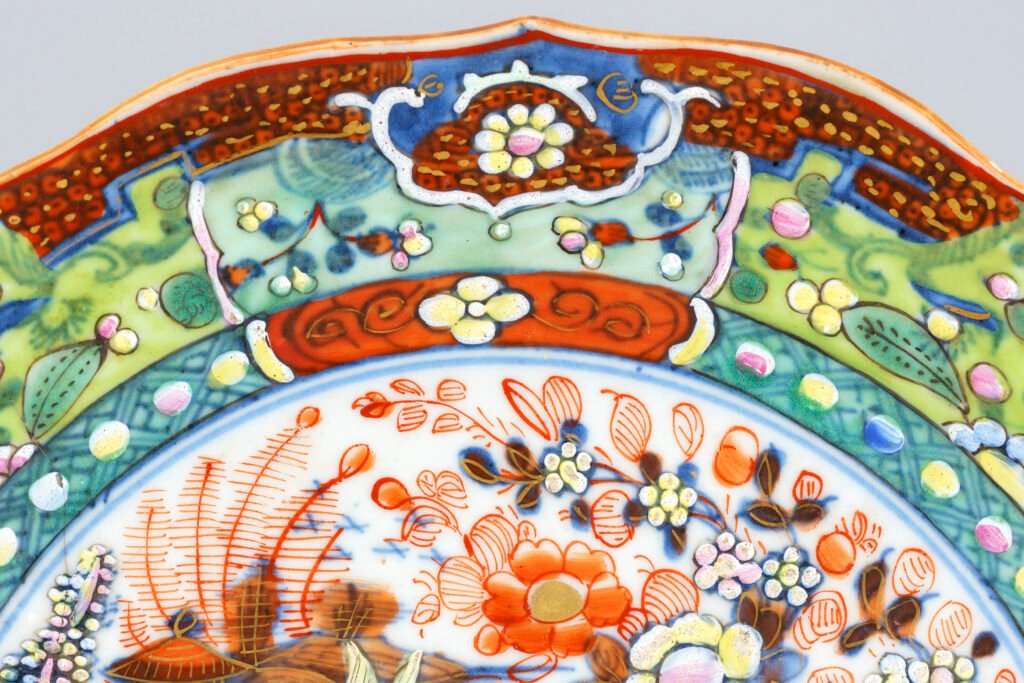
Clobbered Porcelain
Clobbered porcelain is an established antiques-trade term for pottery or porcelain that received additional enamel colours, gilding or painted decoration after its original decoration had been completed.
The term is most frequently applied to Chinese blue-and-white porcelain that was subsequently overdecorated in Europe. However, copper-red, monochrome, Japanese and other Asian ceramics were also treated in this way.
Meaning of “clobbered”
In ceramics, clobbered does not mean that the object has been physically struck. It describes a later decorative intervention applied over an existing and normally complete design.
The word probably relates to older English meanings associated with patching, renovating or cobbling something together. Its precise origin within the ceramics trade is uncertain. The term was already being used for altered porcelain by the 1860s and became increasingly common among collectors during the late nineteenth and early twentieth centuries.
Spellings such as clobbered, clobber, clobb’d and clobbed are all encountered, although clobbered porcelain is the form most commonly used in modern catalogues.
The term traditionally carried a disapproving meaning because collectors often considered the added colours intrusive or damaging to the original Asian design. Modern scholarship generally prefers more precise descriptions such as Chinese porcelain overdecorated in Holland or Chinese blue-and-white porcelain overdecorated in England.
How the decoration was added
The original porcelain had already been formed, glazed, decorated and fired in China or Japan. European decorators then applied coloured overglaze enamels and gilding to its finished surface.
These additional colours were fused to the glaze through one or more low-temperature firings. Gilding could be applied during a separate stage. Because the added decoration was fired at a lower temperature than the original underglaze design, it remained on the surface of the glaze.
On Chinese blue-and-white porcelain, the cobalt decoration remains protected beneath the transparent glaze, while the European enamel colours and gold sit above it. The two decorative stages may therefore have very different patterns of wear.
Why porcelain was overdecorated
European overdecoration was carried out for several reasons:
- To add fashionable polychrome colours to blue-and-white porcelain
- To increase the commercial value of older or inexpensive wares
- To update pieces that had become unfashionable
- To create matching services from unrelated porcelain objects
- To adapt Asian porcelain to contemporary European interiors
- Occasionally, to disguise firing faults, damage or repairs
The presence of later enamel does not automatically mean that an object was damaged. Many pieces received complete, carefully planned decorative schemes purely for fashion and commerce.
Small flowers, insects or gilded motifs may sometimes have been positioned to conceal a flaw, but this should only be described as repair-related clobbering when the added decoration can be shown to overlap damage, filling or another defect.
Dutch overdecoration and Amsterdam Bont
The Netherlands was an important centre for decorating imported Asian porcelain during the early eighteenth century. Chinese and Japanese wares could be imported in blue and white, underglaze copper red or with minimal decoration and then enriched by Dutch enamel painters.
Dutch additions included iron red, green, yellow, aubergine, turquoise and gold. Some decorators worked in Chinese or Japanese-inspired styles, including patterns related to Japanese Kakiemon and Imari porcelain.
The term Amsterdam Bont is frequently used for brightly coloured Dutch overdecoration applied to imported Asian porcelain. The decoration may consist of coherent borders, repeated panels, flowers, figures or complete compositions integrated with the original underglaze design.
Fine early Dutch overdecoration should not automatically be dismissed as crude clobbering. Some eighteenth-century examples were executed to a high standard and were historically mistaken for decoration applied in Asia.
English clobbered porcelain
A distinctive form of dense overdecoration was produced in Britain, particularly during the late eighteenth and early nineteenth centuries. Much of it was applied to older Chinese blue-and-white porcelain.
Red, yellow, green and other strongly contrasting enamels were combined with extensive gilding. Decorators frequently filled the spaces between the original blue motifs with flowers, foliage, figures, panels and ornamental borders. In some cases, the new decoration largely ignored or covered the original Chinese composition.
This colourful appearance suited the rich chinoiserie and Regency interiors fashionable in Britain during the early nineteenth century. It also allowed older imported porcelain to compete with contemporary British ironstone and brightly decorated ceramics produced by manufacturers such as Mason’s and Spode.
Research has connected some early nineteenth-century English clobbering with London decorators and dealers, including a workshop associated with the dealer Unsworth during the 1820s. However, most clobbered objects cannot be assigned securely to a named decorator.
Recognising later overdecoration
Possible indications of clobbering or European overdecoration include:
- Enamel colours crossing over an earlier underglaze-blue design
- Added motifs that do not follow the original composition
- Different painting styles on the same object
- Enamels that appear slightly raised above the glaze
- Greater wear or flaking to the added colours than to the blue beneath
- Gilding placed heavily between or across Chinese motifs
- European figures, flowers or borders combined with Chinese decoration
- An iron-red or gilt decorator’s mark added over the glazed base
A dense design is not proof by itself. Some Chinese porcelain was originally made with underglaze blue and overglaze enamels as part of the same production process. The palette, brushwork, firing and relationship between the different decorative layers must all be considered.
Related terminology
European overdecoration is the most neutral term for enamel or gilded decoration added in Europe to Asian porcelain.
Amsterdam Bont normally describes brightly coloured Dutch decoration added to imported Chinese or Japanese porcelain.
Hausmaler decoration refers to work by independent decorators in German-speaking Europe. These decorators worked on European porcelain as well as imported Asian wares.
English clobbering generally describes the dense and frequently gilded overpainting applied in Britain, especially from the late eighteenth to the early nineteenth century.
Repair overpainting refers specifically to decoration positioned to disguise damage, filling, stains, firing faults or earlier restoration.
Chinese enamelled blue-and-white should be used when the underglaze blue and overglaze enamels formed part of the original Chinese production rather than a later European addition.
Collecting clobbered porcelain
Clobbered porcelain should not automatically be treated as damaged, fraudulent or without value. The quality varies from rough commercial painting to technically accomplished European decoration of considerable historical interest.
The added decoration records changing European attitudes towards Asian porcelain. An object may therefore have two distinct histories: its original manufacture in China or Japan and its later transformation in a Dutch, English or other European workshop.
An accurate description should identify both stages whenever possible, for example:
Chinese porcelain, Kangxi period, originally decorated in underglaze blue and later overdecorated in Holland during the early eighteenth century.
The date of the porcelain body and the date of the added decoration should not be presented as though they were the same.