
Clair-de-Lune
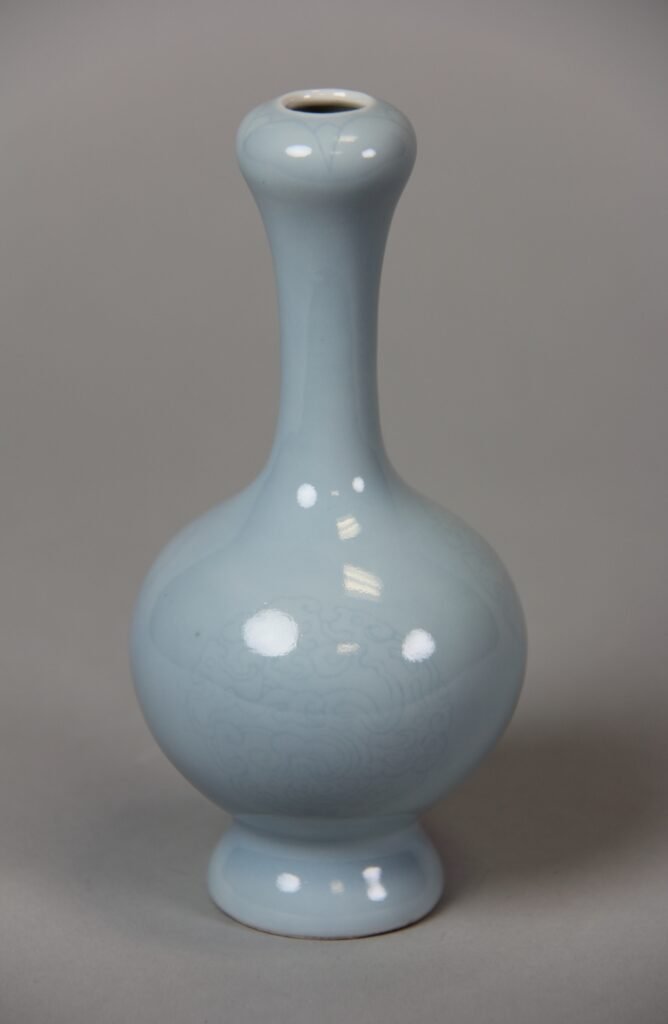
Clair-de-Lune Glaze
Clair-de-lune is a high-fired Chinese monochrome glaze distinguished by its soft, pale blue or blue-lavender colour. It became especially celebrated on imperial porcelain produced at Jingdezhen during the Kangxi reign.
Name and terminology
The French expression clair de lune means “moonlight” and was adopted by Western collectors to describe the glaze’s quiet, luminous appearance.
Several Chinese terms are encountered in museum and auction catalogues. These include tianlan you (天蓝釉), meaning “sky-blue glaze”; tianqing (天青), referring to a sky-blue or blue-green colour; and yuebai (月白), literally “moon-white.” These terms are not always applied consistently and may describe slightly different shades of pale blue.
For this reason, clair-de-lune is best understood as a Western collecting term for a family of related pale-blue Qing monochrome glazes rather than an exact translation of a single Chinese name.
Colour and manufacture
The colour was produced by introducing a small quantity of cobalt into a high-fired glaze. Using considerably less cobalt than required for a deep blue produced a subtle tone ranging from bluish white to pale lavender-blue.
A successful firing created a smooth and evenly coloured surface. Where the glaze collected around the mouth, foot, carved decoration or recessed areas, it could appear slightly deeper and more blue. The thinly glazed high points might appear almost white.
The finest examples have a restrained, luminous colour rather than a strong or brilliant blue. However, terms such as “lavender blue,” “starch blue” and “pale blue” are descriptive rather than precisely defined technical categories.
Development during the Kangxi period
Pale-blue glazes had earlier precedents, but clair-de-lune became a distinctive and highly refined imperial monochrome during the Kangxi reign (1662–1722). It formed part of the considerable experimentation with glaze colours undertaken at the imperial kilns at Jingdezhen.
Many surviving Kangxi mark-and-period examples are small, finely potted objects associated with the scholar’s table. These include brush washers, water pots and miniature vases. They often bear a six-character Kangxi reign mark in underglaze blue.
Some Kangxi clair-de-lune vessels were made in shapes related to the celebrated group of scholar’s objects traditionally known as the ba da ma, or “Eight Great Numbers.” These forms are more commonly associated with peachbloom glaze, while comparable clair-de-lune examples survive in considerably smaller numbers.
It has been suggested that some of these refined miniature vessels may have served as court gifts or presentation objects rather than being intended solely as practical writing-table equipment.
Yongzheng and Qianlong production
The glaze continued to be produced under the Yongzheng (1723–1735) and Qianlong (1736–1795) emperors. During these reigns it appeared on a wider variety of forms, including bottle vases, archaistic vessels, bowls, dishes, censers and jardinières.
Yongzheng-period monochromes are particularly admired for their precise potting, elegant proportions and controlled glaze surfaces. Some vessels were decorated with moulded or incised patterns concealed beneath the pale glaze. This technique, known as anhua or “hidden decoration,” becomes visible when light passes across the surface.
Other examples employ raised white slip decoration, creating a gentle contrast between the pale-blue ground and motifs such as bamboo, orchids, prunus blossom and flowering branches.
Under the Qianlong emperor, clair-de-lune was also applied to archaistic forms inspired by early ritual bronzes and earlier Chinese ceramics. Larger and more elaborate vessels demonstrate that the colour was no longer confined to small scholar’s objects.
Relationship with earlier monochromes
The restrained appearance of clair-de-lune suited the Qing court’s appreciation of earlier Song dynasty monochrome ceramics. Its soft colour and undecorated surface placed emphasis on proportion, potting and glaze quality.
It should nevertheless be distinguished from Ru-type, Guan-type and celadon glazes. These may also appear pale blue or blue-green, but they differ in composition, surface texture and historical inspiration. Ru- and Guan-type glazes are often more opaque and may display deliberate crackling, while classic clair-de-lune is normally smoother and more evenly coloured.
Forms and decoration
Clair-de-lune glaze may be found on:
- Brush washers and water pots
- Beakers and small scholar’s vases
- Bottle and meiping-shaped vases
- Archaistic bronze-inspired vessels
- Bowls and dishes
- Jardinières and planters
- Censers and other court objects
Although many examples are undecorated, the term refers to the glaze rather than to a particular form or decorative method. Incised, moulded, relief and white-slip decoration can all occur beneath or above a clair-de-lune ground.
Identification and later examples
Genuine Kangxi mark-and-period clair-de-lune porcelain is rare. The colour continued to be reproduced during later Qing periods and was imitated during the nineteenth and twentieth centuries. Later pieces may carry apocryphal Kangxi, Yongzheng or Qianlong marks.
Colour alone is therefore insufficient for dating. Examination should include the porcelain body, potting, glaze application, foot construction, form, reign mark and evidence of natural wear. An extremely pale blue glaze should not automatically be identified as early imperial clair-de-lune, while a slightly deeper lavender tone does not necessarily indicate a later date.
The appeal of clair-de-lune lies in its restraint. Unlike strongly coloured monochromes, its effect depends on subtle variations of light across a carefully formed porcelain surface, making successful early examples among the most refined monochromes of the Qing dynasty.