
Aubergine (Eggplant Purple)
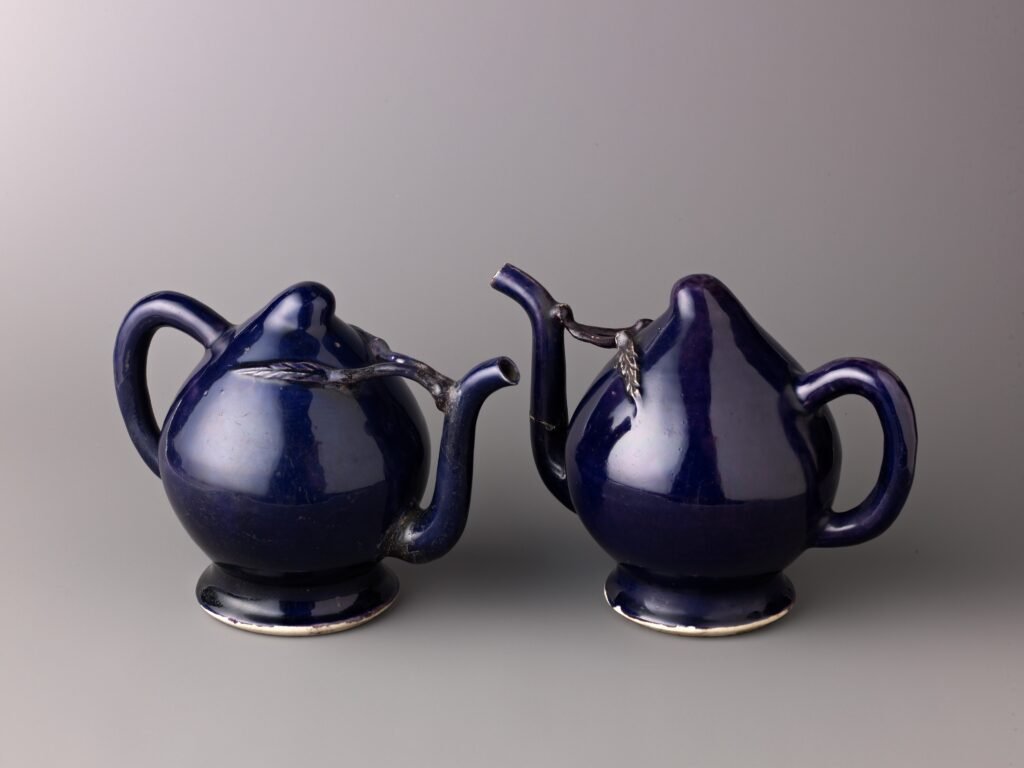
AUBERGINE GLAZE
Aubergine is the Western collector’s name for the purple colour found on Chinese ceramics. It is also described as eggplant purple, brinjal purple or by the Chinese term qiepi zi, meaning “eggplant-skin purple”.
The colour ranges considerably. Aubergine surfaces may appear deep violet, purplish blue, reddish brown, watery lilac or almost black. Differences in the glaze mixture, its thickness, the firing conditions and the presence of other metallic elements all affect the finished colour.
HOW AUBERGINE COLOUR WAS PRODUCED
Manganese was the principal colourant used to create aubergine purple. Naturally occurring manganese-rich materials could also contain cobalt and iron, which altered the tone and sometimes produced a cooler blue-purple or warmer brown-purple appearance.
The colouring material was usually combined with a lead-based mixture and silica to create a low-fired glaze or enamel. The porcelain body was fired first at a high temperature, after which the purple coating was added and the object was fired again at a lower temperature.
On some pieces, particularly Kangxi biscuit porcelain, the coloured enamels were applied directly to the unglazed porcelain body. On others, aubergine was applied over a previously glazed surface. Consequently, auction catalogues and museum records may describe similar purple coatings as either a glaze or an enamel.
AUBERGINE MONOCHROMES
The term qiepi zi is particularly associated with Chinese monochrome porcelain covered almost entirely in a purple glaze. These monochromes were produced in several forms, including bowls, dishes, cups, vases, censers and archaistic vessels.
Some of the finest examples were made during the Kangxi period (1662–1722). Kangxi aubergine monochromes can display a lustrous, translucent purplish-indigo surface that becomes lighter around the rim and darker where the glaze has pooled.
Marked bowls frequently have a white-glazed recessed base carrying a six-character Kangxi reign mark in underglaze blue. Other examples are unmarked or have an unglazed foot or base.
Aubergine monochromes continued to be produced during the Yongzheng and Qianlong periods. Yongzheng examples are especially rare and may have an exceptionally smooth, deep purple-black surface. Qianlong monochromes sometimes combine the glaze with finely incised dragons, flowers, waves or other archaistic decoration.
INCISED DECORATION
Incised designs are an important feature of many aubergine-glazed wares. The decoration was cut into the porcelain before the coloured coating was applied. After firing, the glaze settled into the recessed lines and made the design visible through variations in depth and colour.
Peony scrolls, lotus petals, dragons, clouds and waves were particularly suitable for this technique. On dark pieces, the design may initially appear almost hidden, becoming clearer when the object is examined under angled light.
BRINJAL BOWLS
“Brinjal bowl” is a traditional Western collector’s term for a group of Kangxi-period porcelain bowls decorated with aubergine, green, yellow and occasionally white.
The designs were usually incised into the surface and filled or covered with contrasting low-fired colours. Aubergine dragons may appear against a green or yellow ground, while other examples reverse the colour arrangement.
These bowls belong to the broader tradition of sancai, or three-colour decoration. However, a brinjal bowl should not be confused with an undecorated aubergine monochrome, even though both use a related manganese-purple colour.
EGG-AND-SPINACH AND SANCAI
Aubergine was also used in the mottled decoration known to Western collectors as “egg-and-spinach”. These pieces are splashed with irregular areas of yellow, green, aubergine and sometimes white. The Chinese name for this appearance is often translated as “tiger skin”.
Egg-and-spinach decoration became particularly popular during the Kangxi period and was used on bowls, figures, animals, vessels and decorative objects. It belongs to the long Chinese sancai tradition of combining contrasting low-fired colours.
Related purple, yellow and green combinations can also be found on Ming dynasty fahua wares and on Kangxi susancai porcelain. Aubergine also formed part of the wider famille verte palette, although famille verte, susancai and egg-and-spinach are separate ceramic categories and should not be treated as interchangeable terms.
HOW TO RECOGNISE AUBERGINE GLAZE
Aubergine glaze often becomes thinner and lighter around rims, raised edges and carved details. It may pool into a darker purple or almost black tone in recessed areas. Some examples show subtle blue, brown or red flashes beneath the main purple surface.
Strong photography lights can make a dark aubergine object appear cobalt blue or black. Identification should therefore consider the glaze in natural light together with the porcelain body, foot construction, incised decoration, reign mark and firing characteristics.
Colour alone cannot establish age. Aubergine monochromes, brinjal decoration and egg-and-spinach glazes were all reproduced during the 19th and 20th centuries.
PHOTO CAPTION
Chinese aubergine-glazed porcelain vessels displaying a rich purple-blue surface associated with qiepi zi or eggplant-skin purple.