
Apple Green
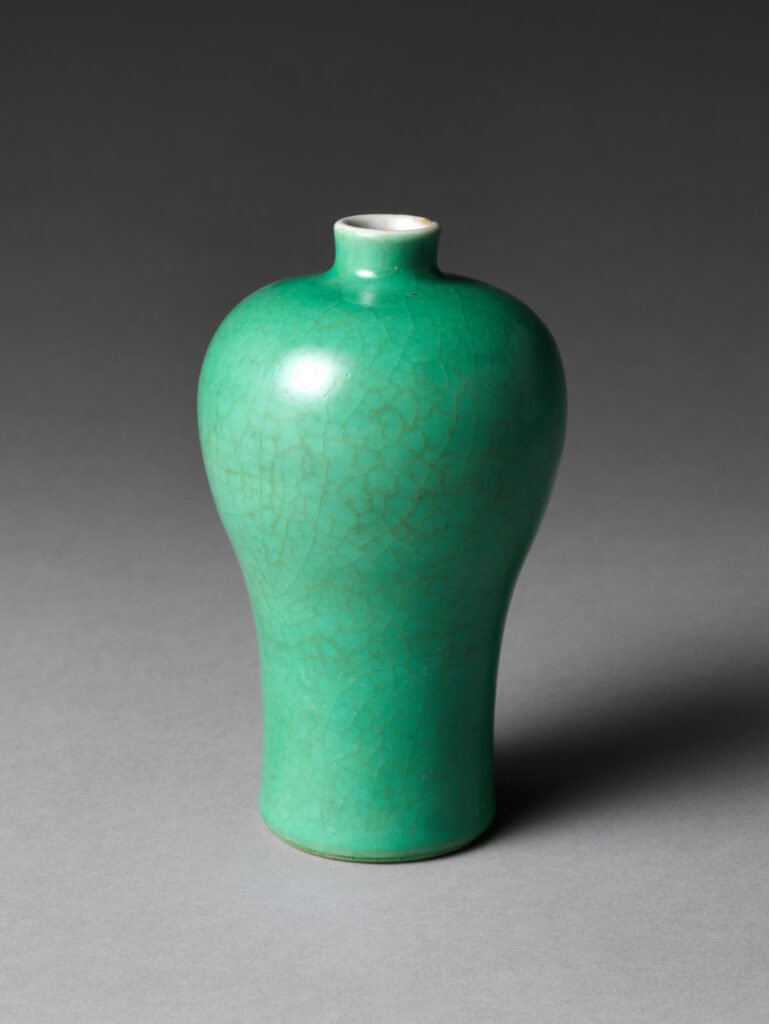
APPLE-GREEN GLAZE
Apple-green glaze is a collector’s term for the fresh green surface found on certain Chinese ceramics, particularly monochrome wares produced during the Qing dynasty. Its colour can range from a delicate pale or melon green to a deeper, brilliant emerald tone.
HOW APPLE-GREEN GLAZE WAS MADE
The classic apple-green surface is composite in nature. The vessel was first covered with a high-fired greyish, buff or stone-coloured glaze, often with a network of fine crackles. A translucent copper-green enamel was then applied over this surface and the piece was fired again at a lower temperature.
The underlying crackle remains visible through the transparent green coating and may appear golden brown, dark brown or black. This creates the distinctive depth and softly mottled appearance associated with many apple-green wares.
However, the term is used somewhat broadly. Not every piece described as apple green has a visibly crackled ground. Auction houses and museums also use the name for thin, smooth green coatings over white porcelain and for richer green enamels applied over carved or biscuit-fired bodies.
HISTORY AND DEVELOPMENT
Apple-green monochromes became established during the Kangxi period (1662–1722). Some Kangxi examples are described as green langyao wares because their translucent, crackled surfaces are related to the celebrated Lang kiln monochromes. Kangxi pieces often display a relatively pale or softly coloured green, although brighter examples are also known.
Production continued and became increasingly refined during the Yongzheng period (1723–1735), when thin and exceptionally even apple-green surfaces appeared on finely potted imperial porcelain. During the Qianlong period (1736–1795), brilliant apple-green enamel was also used on elaborately carved vessels, including imperial pieces decorated with dragons, clouds and waves.
Apple-green wares remained popular during the 19th century. Later examples frequently have a darker, brighter or more intense green colour, although colour alone should never be used to determine age.
HOW TO RECOGNISE APPLE-GREEN PORCELAIN
Typical characteristics include a translucent green surface, fine crackling visible beneath the colour and variations in tone where the coating has pooled. The interior, base or mouth rim may retain a contrasting white, pale celadon, greyish or crackled glaze.
The glaze should always be considered together with the shape, porcelain body, foot construction, surface wear and any reign mark. Crackling by itself does not prove age, as apple-green glazes have been widely reproduced.